
Night-time snow photos

One disturbing symptom of global warming, to those of us above a certain age, is that what I think of as proper winters have become rare in Britain. So rare, in fact, that we’ve had to wait about thirty years for a proper snowfall. As I recall, there was a string of mild winters in the mid to late eighties . . . which gradually became perceived as normal winters . . .

. . . And now, suddenly, it’s quite comforting (unless out in it) to have a normal winter for once. Finally! Except everyone is acting as though it’s never happened before.

I had forgotten a few things about these winters. For example, the noise that the snow makes when it decides it’s time to slide off the roof. But also—if I ever noticed it in the first place—the effect on the light outside.

Close to midnight, several nights running, I was struck by how remarkably light it was outside even with a cloudy sky. Almost as if the sun hadn’t quite finished going down and it were still dusk. I could see things quite clearly which normally would be in darkness. And the clouds in the sky seemed more visible than usual, too.

On reflection, this isn’t too surprising, for the simple reason that snow is white and therefore reflects a lot of light. Several things can happen:

  • Buildings and other surroundings that would normally just be illuminated by the sky will be illuminated by the ground as well, as the “snowlight” reflects onto them.
  • The “snowlight” can reflect back up onto the underside of the clouds.
  • Streetlights, which in places like Manchester already provide significant amounts of light pollution, will also be reflected off the snow onto the underside of the clouds, illuminating the sky a lot more than it usually would.

So I wondered: Is there enough light for my phone camera to manage to take a reasonable photo? I don’t have any way to control how long an exposure it uses, but on the other hand I do have a mini-tripod attachment for it and it does do OK at dusk . . . I expect the result will be quite grainy, but that might suit the kind of photo I’m taking, so let’s have a go . . .

Well, judge for yourself. The original photos I took did rather support my theory about the street lights, by having a very yellow underside to some of the clouds. The effect was a bit horrible. I converted them to black and white. Here’s my favourite of the resulting pictures:
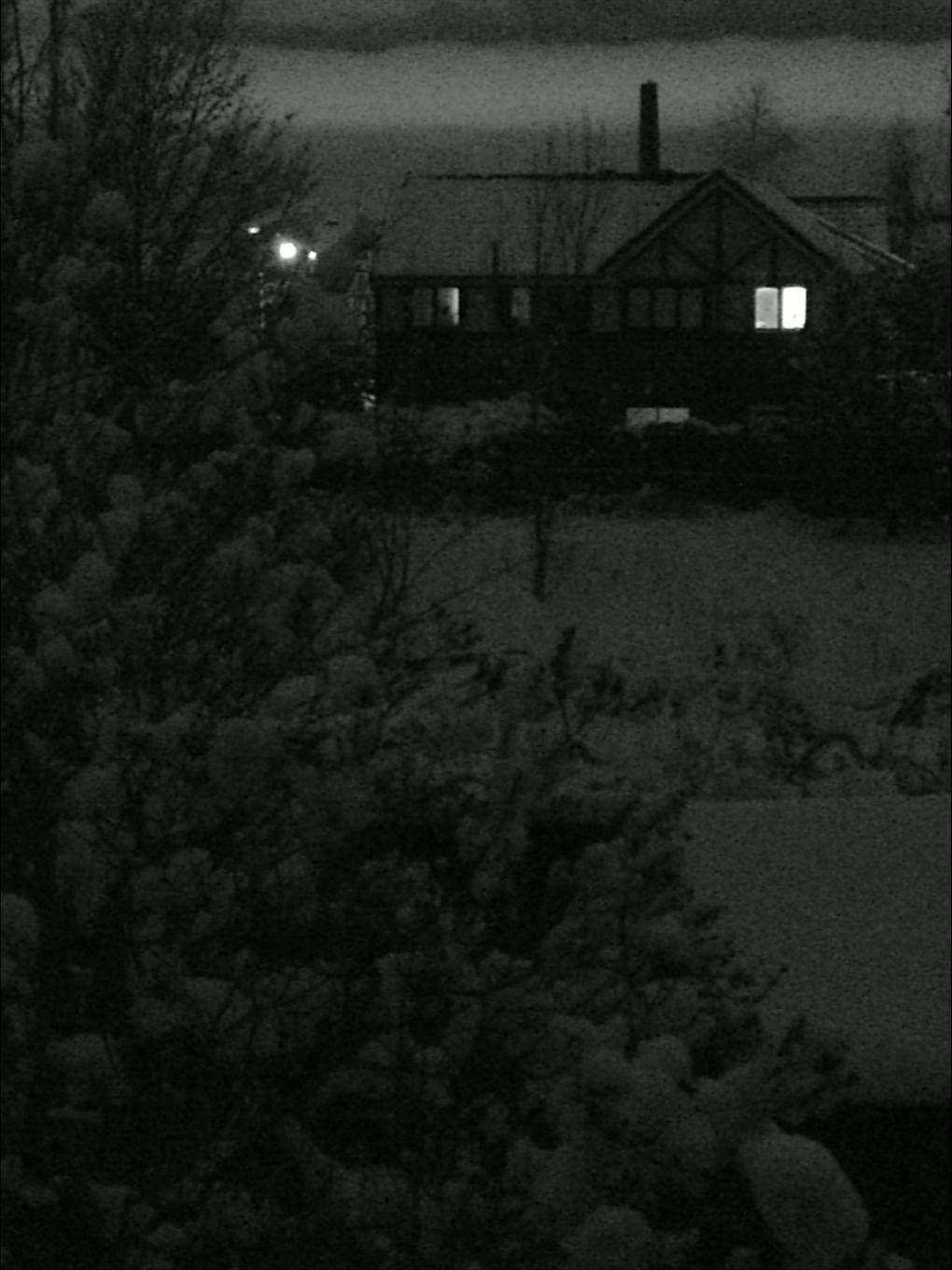
Night-time snow landscape

Snow at night

That’s actually a detail of this larger photo:
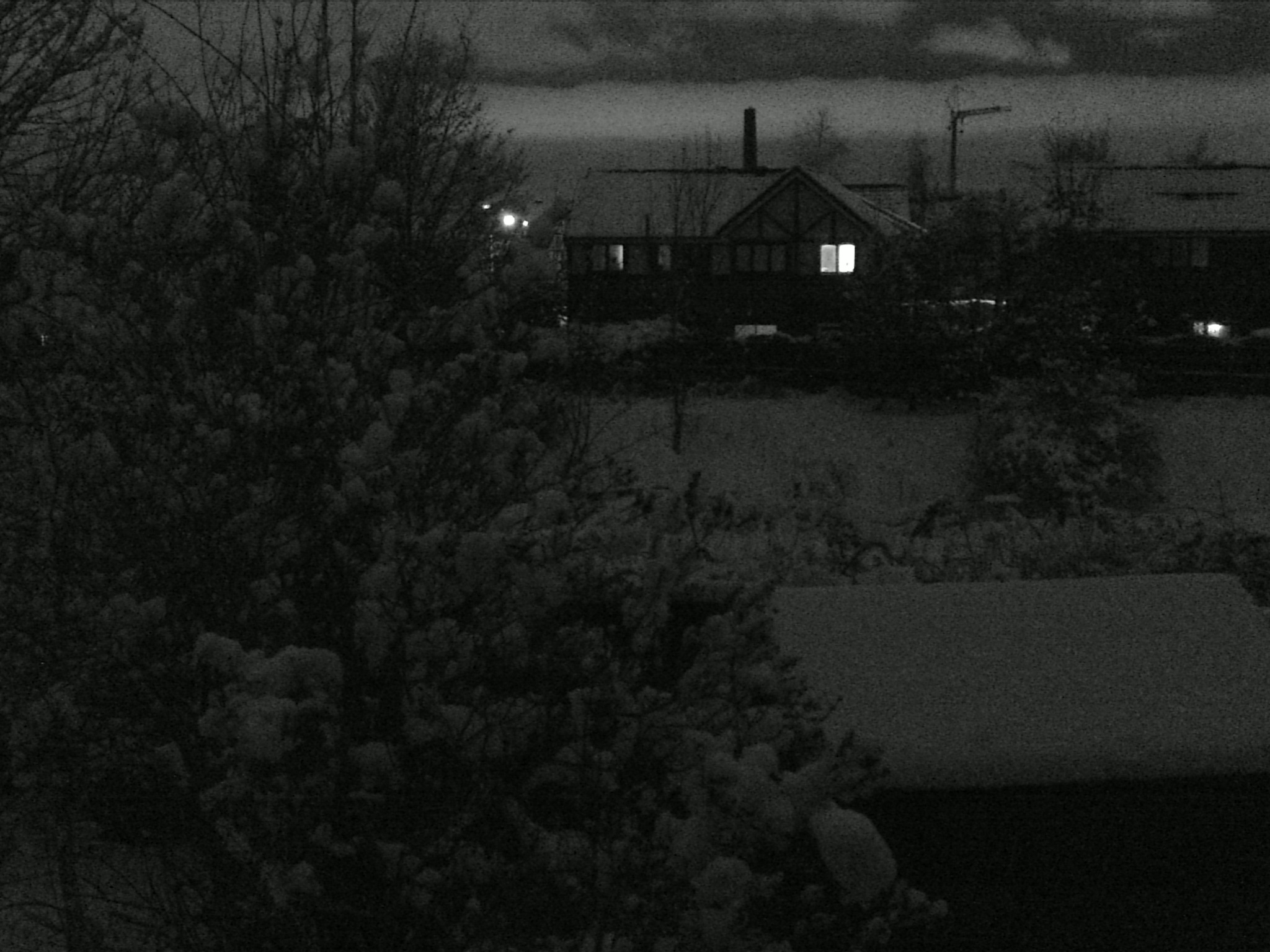
Before cropping

Here’s a different cropped detail of the same photo. Though the tower crane, to the right of the house, is perhaps a bit of a blemish, I was surprised how clearly it shows up considering the graininess of the image.
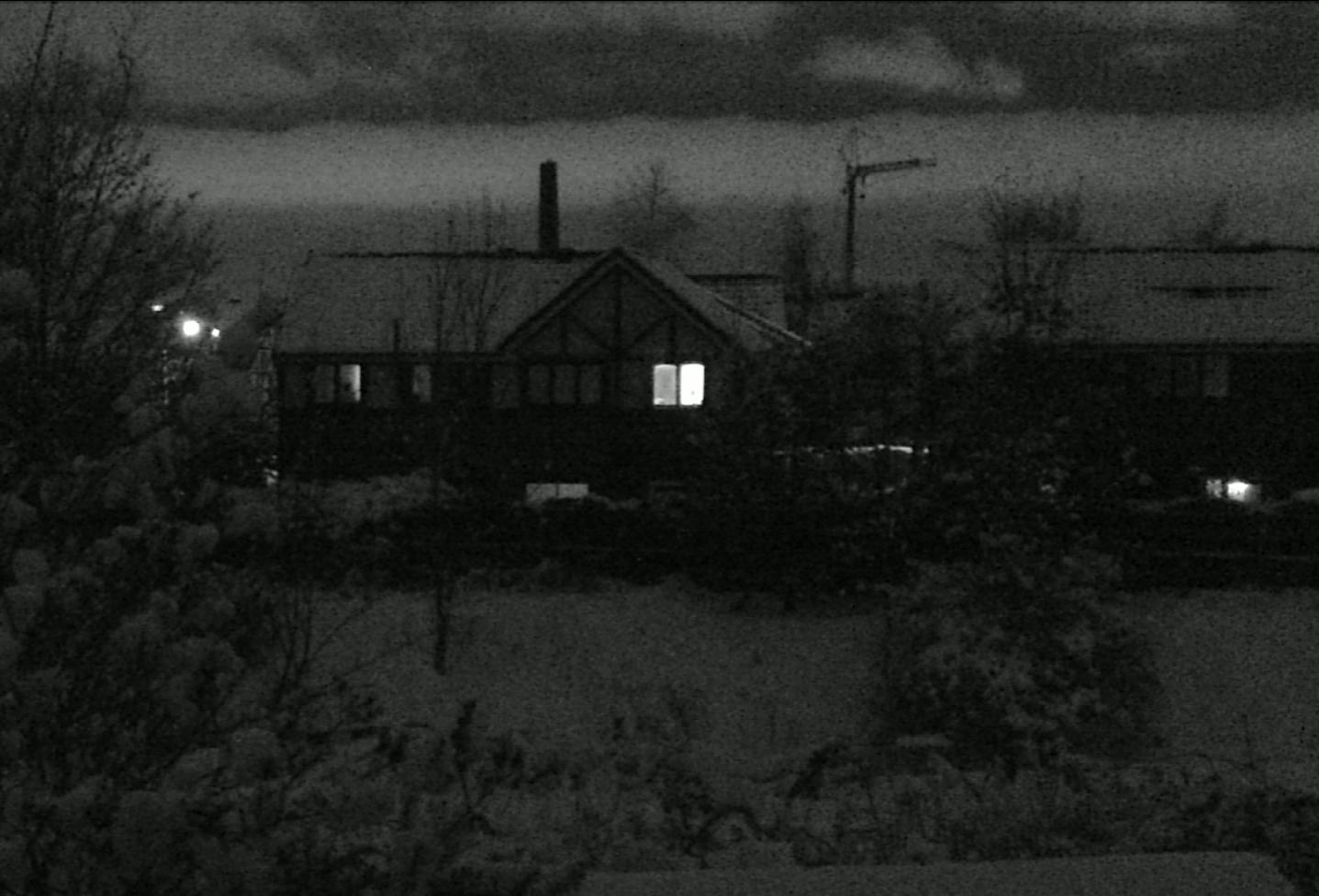
Different detail

And here, for reference, is one of the colour photos, showing the yellow light pollution in all its “glory”:
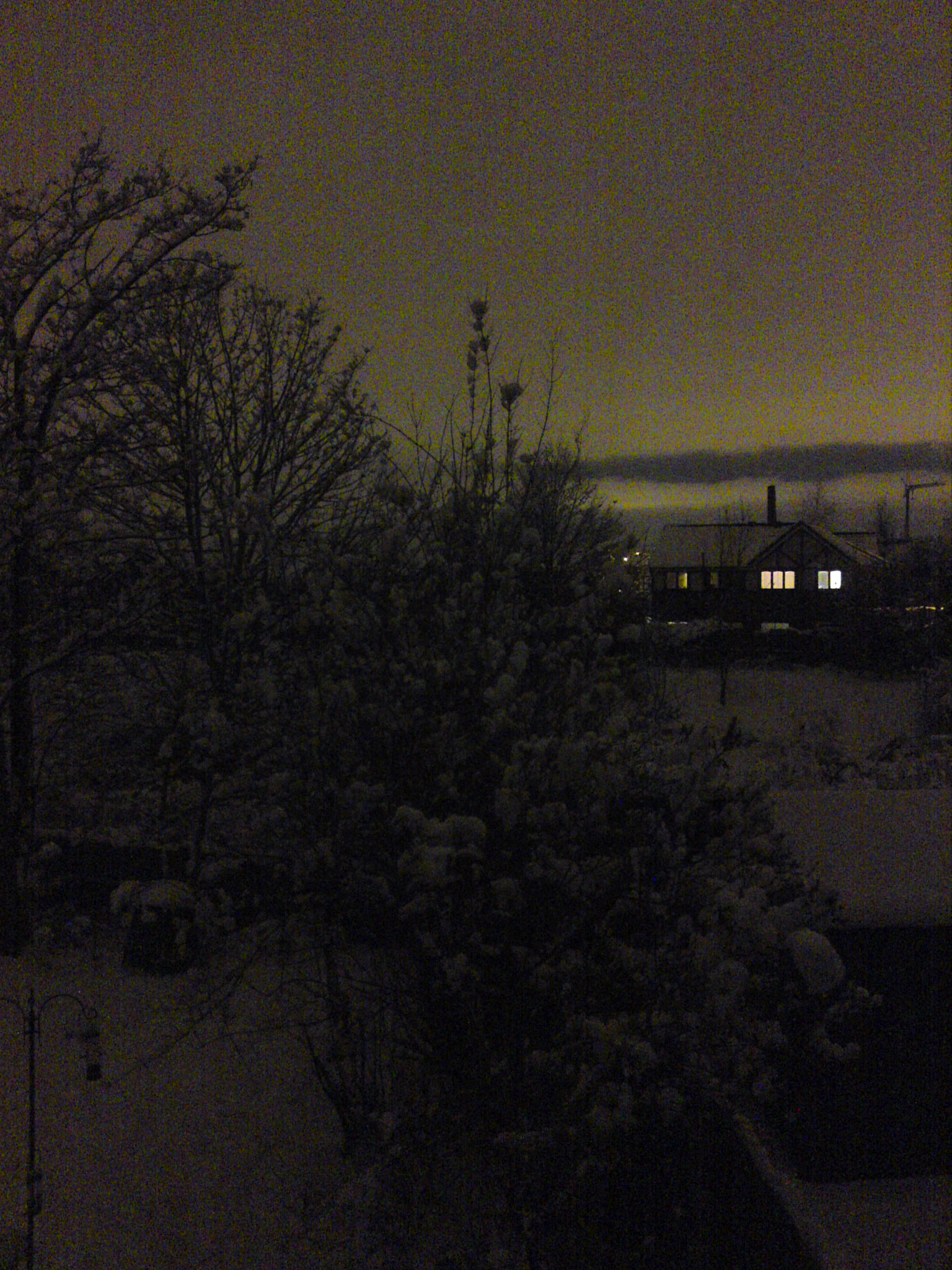
Why I used black and white. Light pollution.

The photos are all taken on a SonyEricsson C905 camera phone, set to 3Mp resolution.
It didn’t work!

Somehow, I never expected that it would. I’m talking about National Blog Posting Month, which I dutifully blogged about at the time.

Bullying myself into an activity was never going to work. So you can rest assured that in the writing of this post and the previous one, no cruelty to the author was involved. 😉

And whether I write more posts will depend almost entirely on whether I feel like it, and whether think I have anything to write about.

The urge returns

No appetite

Some readers will know that I started this blog quite soon after my father died in June 2008. I had been using Twitter to keep friends informed about the progress first of his health, and then of our funeral plans, and after a while I felt the need to start a proper blog.

I think every bereavement is different and each person is affected by it differently. In my case, my energy for playing music was greatly reduced; it simply felt like emotionally the wrong activity. I dropped out of a number of concerts, reduced the number of amateur orchestras I was playing in, abandoned some violin lessons I had been having, and took a break from my usual amount of playing.

The feeling when I tried to play was that the playing was trying to use the same mental and emotional resources which were being used on adjusting after the bereavement. So the energy wasn’t really there, and any energy that was there was needed for that.

As the months passed, I gradually felt able to do more playing, but its nature was basically to agree to play in something, then do the minimum practice required to play adequately. Nothing that involved pushing myself to practise hard.

A dream

Just over a week ago, something happened. I had a dream, in which a number of us were at some kind of party at the house of my violin teacher (who I also know through orchestra). Maybe it was an after-concert party or something. In the dream, it got to about 5 am (it was a good party!) and the teacher said “Tim, do you fancy a violin lesson? … I could do one at 8 o’clock today if you like”. I said that the idea of having one soon sounded quite good, but that I really thought it was time for me to think about going home and getting some sleep rather than staying up even longer in order to have a lesson.

Next day, back in the real world, it got to about 9:30 pm and I felt a strong urge to practise my violin. Well not exactly an urge—more a hunger or a need. A need which had probably been brewing for a while, but which I’d not really been aware of until it came out in the dream.

Hungry again

So I got my violin out. For about an hour, I practised some Sevcik exercises then a Rode study, quite intensely. Then I got out the Bach Chaconne—which I’d worked on before my father died but not played since—and played through it to see how much of it I still knew. (Answer: I still know most of it, but it’s not as fluent and there are places where I now stumble which were fine before.)

Yesterday and today, I again had the desire to practise, and did about 1½ hours each time. And last Tuesday, playing for a Messiah concert, I found myself talking to one of my fellow players about what aspects of technique I’d like to work on if I book a lesson or two.

Is the energy beginning to return? Maybe. It’s about 18 months since I last felt this way, so I think it may well be a good sign. Will I book a lesson? Maybe. I’ve already got as far as texting the teacher to ask what she charges these days.

Some linguistic insanity

We’ve all heard stories of bizarre sentences resulting from, say, translating a piece of English into Russian and back again. I’m never sure whether these are true, apocryphal or embellished.

Well, yesterday I came across a website called Translation Party whose function is simply to generate these. It doesn’t translate things into Russian: you provide a piece of text, and it then repeatedly translates it into Japanese and back again until it achieves “equilibrium”. That is, it stops when translating the English text it has arrived at into Japanese and back no longer changes the text. I think it uses Google Translate or some such thing.

Here, for example, is the chain of English “sentences” resulting from typing in “shall I compare thee to a summer’s day?”:

  • shall I compare thee to a summer’s day?
  • I was on a summer’s day, what should you compare?
  • I am on the day of the summer, compared to what it was?
  • I, on the day of the summer, do you have anything to compare it?
  • I, on the day of the summer, if you have nothing to compare it?
  • I, for the summer, to compare what is not?
  • I was in the summer of 2006 in comparison to what was not?
  • I have the summer of 2006, what was that compared to?
  • I have compared to the summer of 2006 or any year?
  • I compared the summer of 2006, or any year?
  • My summer of 2006, or any year comparison?
  • My summer of 2006, or any comparison of the year?
  • My summer of 2006, or from any comparison?
  • My summer of 2006, or from or any comparison?
  • My summer of 2006, any comparison or later?
  • In the summer of 2006 I was, or any comparison?
  • The summer of 2006, or is he or any comparisons?
  • Summer of 2006, or any comparison of him?
  • Summer of 2006, any comparison of him?
  • Summer of 2006, any comparison of him?

Don’t ask me where 2006 came from (as I don’t speak Japanese, and therefore have no idea.)

Interestingly, if I make the tiny correction of capitalising the beginning of the starting sentence, 2006 doesn’t get mentioned at all and the site arrives at

  • This summer, like me, you can compare what you are?

via a much shorter chain of sentences which includes the decidedly un-Shakespearean

  • This summer, I was like, What can compare?

I have a horrible feeling that in not many years’ time that may well be standard English grammar.

Each time you enter some text, the website creates a link to the resulting page. Thus if you want to see the steps which led from this tweet from one of my Twitter contacts

  • Good evening, people. 🙂 Wow, now that I sat down again I’m tired. Ug

to

  • Evening, good people. I am now on a Saturday, I’m currently in Uganda 🙂

all you need do is go to http://translationparty.com/#1013689.

Have fun!

How to make coffee without losing friends

You’ve probably noticed two trends in the instruction manuals or leaflets which come with consumer items. For one groups of items—mobile phones for example—the trend is towards giving less and less useful information. For example, my new phone has a red light on the side which sometimes flashes. It must do this for a reason, to indicate something, but I’ve no idea what and the manual doesn’t tell me. In fact much of the manual consists of sentences beginning “You can . . .” which mention a particular task but don’t actually mention how to do it.

The other trend is towards giving more and more unnecessary information—for example, telling you that candles burn and that the flame is hot.

Many sets of instructions are also written in barely intelligible English, translated from another language by a non-native speaker of English. Personally I think such translations should be required to meet a minimum legal standard, since confusion can in some cases be dangerous and in others can make certain features of a product unusable. If the instructions for a feature can’t be deciphered, then the feature is effectively not there and you may just as well have been sold a faulty product.

A couple of weeks ago I bought myself a Russell Hobbs coffee grinder, in order to let me drink nice, freshly ground coffee. It works very well.

My first reaction to the instructions that came with it was that it was a breath of fresh air to read ones which were obviously written by someone who knew English. Every word was intelligible.

My second thought was that they were rather detailed, but since a lot of the detail concerned safety and the reasons for various things, that was still OK.

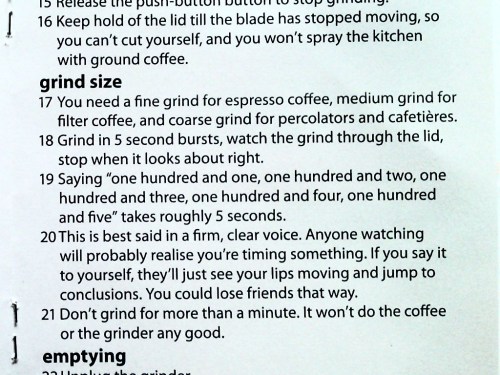
What I wasn’t expecting, though, was the advice on personal relationships in step 20:

Extract from Russell Hobbs instruction manual

Item 16 is reasonable, though amusingly worded. So are items 17 and 18, though the writer appears either not to have heard of semicolons or to have missed an and out. Item 19 is certainly an adequate way of counting approximate seconds. But item 20???

That made me laugh out loud, but I’m wondering how on earth it made its way into an actual instruction booklet. In a draft as a joke when someone had been drinking, maybe . . . but the final booklet? For a well-known manufacturer? Do they know what is going out in their name?

I confess that when I grind the coffee, I don’t count in a “firm, clear voice”. I either time the bursts with my watch, or count quietly and take the risk of people jumping to conclusions.