Tag Archives: language

Nobody has an accent

In 2008, an American friend of mine returned to live in the US after twenty years here in Britain. Recently she applied for a new job, via a two-stage interview process. It’s a job in which diversity of backgrounds between workers is important.

The man who gave her initial interview recommended her for the second stage. Excellent news. But she was bemused when he then advised her “not to bring up the subject” of where she was originally from.

When she rang the woman who was to do the second interview, she was surprised to hear a northern English accent at the other end of the phone. And it fell into place.

She herself still has a thoroughly American accent: not an Alistair Cook accent; not the certain type of American accent which can be confused with a certain type of Irish one; unambiguously American. Except to Americans.

Where I live, there are easily perceptible changes in the local accent over distances as short as five miles. But they’re only easily perceptible if you grew up locally yourself and are familiar with them. To me, my friend’s accent could only possibly be American. I would have no way of knowing from her voice that she had ever lived in Britain, though her familiarity with every aspect of British life would be a bit of a giveaway. I can’t hear a trace of anything non-American in it.

To other Americans, however, she sounds British. So British, in fact, that the man who interviewed her thought that if she didn’t mention having been born in the States, she would sound British to a British-born interviewer . . . but there’s no chance of that. No chance at all.

It was funny (though I hope she gets the job!). It was also interesting: it shows just how different our perceptions of a voice can be from someone else’s. I’m not an expert in phonetics, but it seems to me that most of us feel that we ourselves don’t have any accent, and neither do other people who speak the same as us. We don’t hear the whole of the accent: we hear the deviations in the pronunciation of the various phonemes from the way we ourselves say them. And that makes sense: the differences between us are what make us recognisable as our individual selves.

My friend’s experience, I think, is an example of that: I can only hear the features of her speech which make her sound American, whereas her interviewer could only hear the features which make her sound British.

More seriously, I think our minds can sometimes work the same way when it comes to ideas, and especially deeply-held ones such as religious or political beliefs. Conflict often comes from thinking that because one particular aspect of someone’s thinking is different from ours, we have nothing else in common either. That’s how we are able to have enemies and fight wars. But I don’t want to get into that now. I just want to share the story and be fascinated by the way spoken language works.

And lest you should think the difference in hearing English accents just applies to English speakers: in Germany, I once asked an old lady in the street for directions somewhere. She asked me “Sind Sie english oder amerikanisch?”—”Are you English or American?”. All she could hear was that I had an English-speaker’s accent, but not whether it was a British or American one.

A long-lost newspaper cutting

Talking of things from the past unexpectedly surfacing: here’s a newspaper cutting which I saved in 1985. (Good grief, that’s 25 years ago! Ahem . . . ) I mislaid it for a while, and then was delighted to find it again a few months ago.

It dates from my time living in Bangor, North Wales, and is a letter to the local free newspaper. There was an election coming up. Bilingual leaflets were produced by the parties, in English and Welsh. Well sort of. Here is one resident’s reaction to what came through the letterbox:

Newspaper cutting in deliberately misspelt English, complaining about poor Welsh translations

From the free Bangor newspaper, c. 1984

By the way, some of the spellings in the above make more sense if you’re familiar with the basics of Welsh pronunciation and with the Gwynedd local accent: for example, ffrynt in the first sentence is an almost perfect representation in Welsh spelling of how the English word front would be pronounced locally.

Now the question in my mind is: how bad are the translations in today’s election campaigns? Have they improved at all? My hope is that they have, but I wouldn’t be too surprised to hear that they haven’t.

Anyone know?

Some linguistic insanity

We’ve all heard stories of bizarre sentences resulting from, say, translating a piece of English into Russian and back again. I’m never sure whether these are true, apocryphal or embellished.

Well, yesterday I came across a website called Translation Party whose function is simply to generate these. It doesn’t translate things into Russian: you provide a piece of text, and it then repeatedly translates it into Japanese and back again until it achieves “equilibrium”. That is, it stops when translating the English text it has arrived at into Japanese and back no longer changes the text. I think it uses Google Translate or some such thing.

Here, for example, is the chain of English “sentences” resulting from typing in “shall I compare thee to a summer’s day?”:

  • shall I compare thee to a summer’s day?
  • I was on a summer’s day, what should you compare?
  • I am on the day of the summer, compared to what it was?
  • I, on the day of the summer, do you have anything to compare it?
  • I, on the day of the summer, if you have nothing to compare it?
  • I, for the summer, to compare what is not?
  • I was in the summer of 2006 in comparison to what was not?
  • I have the summer of 2006, what was that compared to?
  • I have compared to the summer of 2006 or any year?
  • I compared the summer of 2006, or any year?
  • My summer of 2006, or any year comparison?
  • My summer of 2006, or any comparison of the year?
  • My summer of 2006, or from any comparison?
  • My summer of 2006, or from or any comparison?
  • My summer of 2006, any comparison or later?
  • In the summer of 2006 I was, or any comparison?
  • The summer of 2006, or is he or any comparisons?
  • Summer of 2006, or any comparison of him?
  • Summer of 2006, any comparison of him?
  • Summer of 2006, any comparison of him?

Don’t ask me where 2006 came from (as I don’t speak Japanese, and therefore have no idea.)

Interestingly, if I make the tiny correction of capitalising the beginning of the starting sentence, 2006 doesn’t get mentioned at all and the site arrives at

  • This summer, like me, you can compare what you are?

via a much shorter chain of sentences which includes the decidedly un-Shakespearean

  • This summer, I was like, What can compare?

I have a horrible feeling that in not many years’ time that may well be standard English grammar.

Each time you enter some text, the website creates a link to the resulting page. Thus if you want to see the steps which led from this tweet from one of my Twitter contacts

  • Good evening, people. 🙂 Wow, now that I sat down again I’m tired. Ug

to

  • Evening, good people. I am now on a Saturday, I’m currently in Uganda 🙂

all you need do is go to http://translationparty.com/#1013689.

Have fun!

How to make coffee without losing friends

You’ve probably noticed two trends in the instruction manuals or leaflets which come with consumer items. For one groups of items—mobile phones for example—the trend is towards giving less and less useful information. For example, my new phone has a red light on the side which sometimes flashes. It must do this for a reason, to indicate something, but I’ve no idea what and the manual doesn’t tell me. In fact much of the manual consists of sentences beginning “You can . . .” which mention a particular task but don’t actually mention how to do it.

The other trend is towards giving more and more unnecessary information—for example, telling you that candles burn and that the flame is hot.

Many sets of instructions are also written in barely intelligible English, translated from another language by a non-native speaker of English. Personally I think such translations should be required to meet a minimum legal standard, since confusion can in some cases be dangerous and in others can make certain features of a product unusable. If the instructions for a feature can’t be deciphered, then the feature is effectively not there and you may just as well have been sold a faulty product.

A couple of weeks ago I bought myself a Russell Hobbs coffee grinder, in order to let me drink nice, freshly ground coffee. It works very well.

My first reaction to the instructions that came with it was that it was a breath of fresh air to read ones which were obviously written by someone who knew English. Every word was intelligible.

My second thought was that they were rather detailed, but since a lot of the detail concerned safety and the reasons for various things, that was still OK.

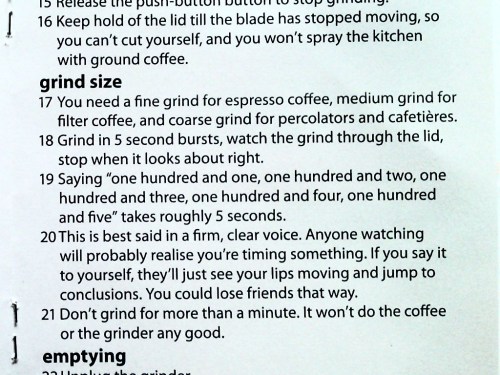
What I wasn’t expecting, though, was the advice on personal relationships in step 20:

Extract from Russell Hobbs instruction manual

Item 16 is reasonable, though amusingly worded. So are items 17 and 18, though the writer appears either not to have heard of semicolons or to have missed an and out. Item 19 is certainly an adequate way of counting approximate seconds. But item 20???

That made me laugh out loud, but I’m wondering how on earth it made its way into an actual instruction booklet. In a draft as a joke when someone had been drinking, maybe . . . but the final booklet? For a well-known manufacturer? Do they know what is going out in their name?

I confess that when I grind the coffee, I don’t count in a “firm, clear voice”. I either time the bursts with my watch, or count quietly and take the risk of people jumping to conclusions.

A grammar puzzle

English grammar can be strange. Sometimes it seems to have a rule of breaking its own rules, as it were. An example that occurred to me yesterday involves the words less and fewer. I’ll tell you about it shortly, but I need some background first.

A rule

First consider the basic rule about these words:

  • fewer refers to things you can count
  • less refers to things you can’t count: continuous quantities.

So, for example, if you drop one of your plates on the floor while washing up and it shatters, you have fewer plates than you did before. But if you eat a larger piece of cake than planned, there is less cake left than there would have been otherwise.

Some exceptions which aren’t

This seems like a clear enough rule, and it’s one which we mostly adhere to in written English. Fowler [1], though, mentions a few apparent exceptions, such as

  • It is less than seventy miles to London
  • [It] costs less than fifty pounds
  • We have had reliable temperature records for less than 150 years
  • [Please write] fifty words or less.

On closer inspection, the first three of these turn out to fit the rule.Try using fewer in those examples: It is fewer than seventy miles to London sounds (at least to me) as though the distance to London has to be a whole number of miles. But it isn’t: distance is a continuous quantity, which just happens to be measured in miles. We aren’t counting the number of miles, but measuring the distance.

Similarly the time since temperature records began is unlikely to be a whole number of years, and we’re measuring the time, not counting individual years; less than 150 years really means “A time whose length is shorter than 150 years”.

The money example seems slightly different, since money does come in distinct steps. However, the steps are pence, not pounds. Normally you won’t get the correct price of something by counting out a number of pounds, and (at least to my ears) fewer than fifty pounds sounds like doing precisely that. We generally think of money as a thing which we have a lot or a little of, not as a pile of coins which we have many or few of. So it still fits the rule.

Fifty words or less is interesting because, as Fowler points out, it is standard wording for English exams. A whole number of words is definitely what’s wanted. But the emphasis is still really on the length of the passage to be written, not on the individual words.

As a borderline case, Fowler  gives having had in his house at one time no less than five Nobel Prize winners. I’m less happy about that one: I think that in written English it should definitely be no fewer than five of them. Nobel Prize winners seem to me to be something that you definitely have a whole number of, not something that you measure out. On the other hand, maybe when you have a crowd of Nobel Prize winners your attention is on the size of the crowd rather than on the individuals. But I somehow doubt it. Nevertheless, these examples do in fact fit the rule: fewer for things you count, and less for things you don’t. I’m merely a little dubious about the idea of not counting Nobel Prize winners.

Speaking colloquially

I’ve not studied the speech aspect of this, but it’s clear that many (maybe most) people often don’t adhere to this rule when speaking. They say things like I’ve got far less things to do today and might treat less things to doless work to do and less to do as equivalents which are all variants on the idea of doing less.

Are they speaking “incorrectly”, or are they using a different set of rules of “correctness” for speech? I’m not sure: to me this one does feel more like not noticing a word that doesn’t fit properly, thereby getting it wrong,  than like using a different rule  to determine what fits. But at the same time, carefully using fewer can feel artificial at times, creating too much formality, especially in situations where it’s harder to say or when speaking to someone who doesn’t use it. Far fewer feels more awkward to the mouth than far less, for example, and I think there probably is a “rule” in speech  of using phrases which have a smoother sound to them. Maybe sounding nice sometimes takes precedence over “correctness”. But whether it actually sounds nice to the listener will of course depend on how alert they are to the grammatical structures, how bothered they are by it, and whether it affects clarity of meaning.

The puzzle

OK, that was rather a lot of background. Here is the puzzle, though it may be that I just hear things a particular way which other people don’t share. I’d like to hear other people’s opinions on it. It concerns the situation where, say, someone has some things to  do and then does one of them. The situation afterwards can be expressed in a variety of ways. Some feel more natural than others; some seem more grammatically logical than others. This is how it looks to me, though it may be different for someone else:

Acceptable
  • I now have fewer things to do.
  • I now have one less thing to do.
  • I now have one thing less to do.

These all feel to me like natural ways of saying it.

Less acceptable
  • I now have less things to do.
  • I now have one thing fewer to do.

Less things to do feels natural as a spoken expression, but either wrong or borderline as a written one. One thing fewer is verging on awkward: not exactly wrong, but not a very natural expression either.

Unacceptable (to my ears)
  • I now have one fewer thing to do. (No no no! One less!)
  • I now have one fewer things to do. (“One things?!”)

And there’s the puzzle.

  • How many things do you have to do? Fewer. You have  fewer things to do.
  • How many fewer? One. You have one fewer things to do.

And yet, far from being the correct expression, one fewer things to do is the most unambiguously wrong one of the lot.

On the other hand, if two tasks are done instead of one,  fewer becomes OK again: I have two fewer things to do.

At first sight, this is all very puzzling. The questions are ones like these:

  • Why can I have fewer things to do but not one fewer things to do?
  • Why can I have  one less thing to do but not one fewer thing to do?
  • Given that the things to do are ticked off my list one by one, why does less rather than fewer end up being the apparently correct word?

Attempt at an answer

The problem with the two versions I listed as “unacceptable” seems to be  that however much we may want them to be logical, they refuse to read that way.  One fewer things to do insists on reading as though fewer qualifies one things, so singular and plural are mismatched. One fewer thing to do tries to make fewer thing into a valid element. But we know that fewer applies to more than one of something. What’s rather strange, though, is that one less thing to do doesn’t seem to suffer from the same problem, even though less thing isn’t really any more valid an element than fewer thing. Maybe it’s chosen simply because it doesn’t leap out quite so blatantly.

(By the way, I really wish I had a quick way to draw some sentence diagrams here.)

From my list, I think the three “least incorrect” versions are

  • I now have one less thing to do.
  • I now have one thing less to do.
  • I now have one thing fewer to do.

In all cases, there is one thing which has already been done. This leaves less/fewer [things] to  do. But if we test the structure by removing fewer or less from the sentences, we see that they are all versions of I now have one thing to do, which isn’t the situation. The one thing is precisely the one which doesn’t need doing.

So the grammar is confusing because it tries to have its cake and eat it. Structurally, less to do and fewer to do are firmly attached to the one thing. But in their actual meaning, they refer to something entirely different: all the other things to do, which are nowhere to be seen in any of the three sentences. They’re trying to refer to two conflicting things at once.

Finally, if we instead remove the one thing from the three sentences to see what structure is left, we end up with

  • I now have less to do
  • I now have fewer [things] to do.

If the most natural phrase were I now have one thing less to do, this would give us our answer: it means “I now have less to do, by one thing”. Interpreted this way, the sentence is grammatically correct and self-contained. However, I think the most natural one is one less thing, not one thing less, so either some illogicality remains, or something unidentified is still going on.

I would welcome any thoughts on this! In particular, on whether my feeling as to the relative acceptability of the different constructions coincides with yours. There may be regional or international differences, or you might simply have gravitated towards a different usage from mine.

Note

[1] R W Burchfield (ed.). The New Fowler’s Modern English Usage, Oxford University Press, 1996, p. 295. Back