Tag Archives: humour

“Greatest Hits of the Second Viennese School”

Recently I came across this. It’s . . . Well, what it says. A spoof advert for atonal music. Much of the humour comes from picking out entirely the wrong feature of a musical passage for comment—e.g. commenting on the tunefulness of a passage which consists entirely of harmony and orchestral colour, or the tenderness of . . . Watch it and see.

As a violinist, I particularly like “the virtuoso violin writing of Alban’s Violin Concerto In case you don’t know, the concerto starts with the soloist playing the four open strings. (By the way, you can see someone performing the concerto here. Oddly, the vibrato in the audio seems not to match his hand movements in the video.)

Actually the video is rather unfair to Schoenberg. And I quite like atonal music. So, here to redress the balance is a more serious one: an interview with Schoenberg about his paintings and his music, recorded in 1949.

Follow the “related video” links for more material, both serious and otherwise.

Diagram Prize update

A few posts ago, I wrote about the Diagram Prize, awarded for “the book carrying the oddest title of the year”. There was a shortlist of six titles, and members of the public were invited to vote on which should win.

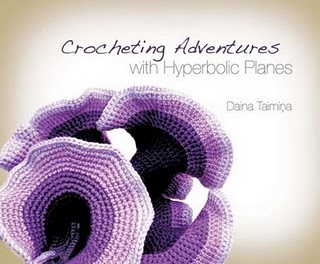
Book cover showing a crocheted hyperbolic plane

Winner of the 2009 Diagram Prize

The 2009 winner has now been announced on The Bookseller‘s website, and is Crocheting Adventures with Hyperbolic Planes by Dr Daina Taimina.

If you read the article, be sure to scroll down to the comments—the first is from Dr Taimina herself and gives her response to winning.

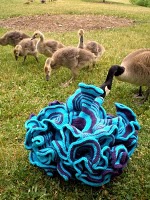
Another crocheted hyperbolic plane

If you want to know more about the the book and its author, visit her blog at http://hyperbolic-crochet.blogspot.com/. You can also follow her on Twitter at @DainaTaimina.

Further update: When I wrote that, Daina Taimina had only just started her blog. Now that it’s been going a little longer, it’s showing signs of becoming a fascinating blog about art and mathematics, with a strong personal slant too. I do urge you to visit it.

Images © Daina Taimina and used with permission.

A long-lost newspaper cutting

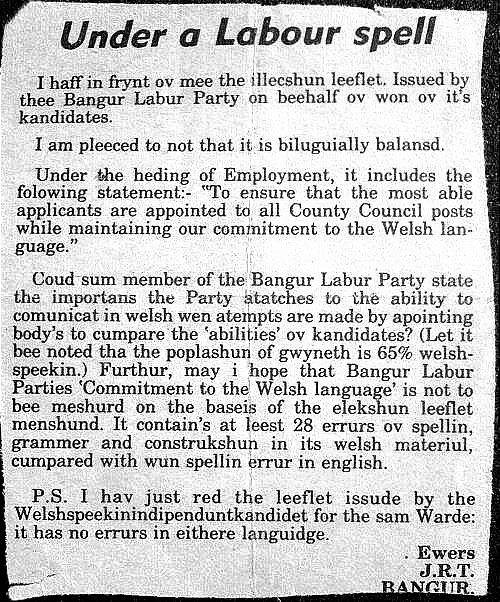
Talking of things from the past unexpectedly surfacing: here’s a newspaper cutting which I saved in 1985. (Good grief, that’s 25 years ago! Ahem . . . ) I mislaid it for a while, and then was delighted to find it again a few months ago.

It dates from my time living in Bangor, North Wales, and is a letter to the local free newspaper. There was an election coming up. Bilingual leaflets were produced by the parties, in English and Welsh. Well sort of. Here is one resident’s reaction to what came through the letterbox:

Newspaper cutting in deliberately misspelt English, complaining about poor Welsh translations

From the free Bangor newspaper, c. 1984

By the way, some of the spellings in the above make more sense if you’re familiar with the basics of Welsh pronunciation and with the Gwynedd local accent: for example, ffrynt in the first sentence is an almost perfect representation in Welsh spelling of how the English word front would be pronounced locally.

Now the question in my mind is: how bad are the translations in today’s election campaigns? Have they improved at all? My hope is that they have, but I wouldn’t be too surprised to hear that they haven’t.

Anyone know?

Your vote is needed!

A while ago I subscribed to emails from The Bookseller, the trade magazine for publishing in the UK. I did this for the worthy reason that it’s a good place to look for opportunities for freelance proofreading and copy-editing.

Today they sent me a very nice change from the usual email full of publishing jobs. It invited me to “Vote on the world’s most prestigious literary prize”. The Diagram Prize, to be precise. I confess that I’d never heard of it, however prestigious it may be.

I read on:

The Diagram Prize is an annual award bestowed upon the book carrying the oddest title of the year . . .

Run by The Bookseller magazine, the prize was first awarded in 1978 – to Proceedings of the Second International Workshop on Nude Mice – and was conceived to alleviate boredom during the Frankfurt Book Fair.

Ah. So  prestigious is being  used somewhat loosely, to mean entertaining. Rather as an IgNobel Prize is the world’s most prestigious science prizes.

There was a list of book titles, and finally an invitation to forward the email to “any odd friends that like books or friends that like odd books”. But blogging about it seemed more fun, so I’ve done that instead.

The books in this year’s shortlist are:

  • Collectible Spoons of the 3rd Reich, by James A Yannes
  • Afterthoughts of a Worm Hunter, by D W T Crompton
  • Governing Lethal Behavior in Autonomous Robots, by Ronald C Arkin
  • The Changing World of Inflammatory Bowel Disease, by Ellen Scherl and Marla Dubinsky
  • Crocheting Adventures with Hyperbolic Planes, by Daina Taimina
  • What Kind of Bean Is This Chihuahua?, by Tara Jansen-Meyer

Titles from the “very longlist” which sadly didn’t make it to the shortlist include How YOU™ Are Like Shampoo and Map-based Comparative Genomics in Legumes. Last year’s winner was The 2009–2014 World Outlook for 60 mg Containers of Fromage Frais by Prof. Philip M Parker.

Clearly this is an important award. I didn’t see any mention of what the winner receives—a 60 mg container of fromage frais, maybe?—but the stakes are high.

Winners are announced on March 26th. You can vote by visiting http://www.thebookseller.com/ and scrolling down to just below Blogs in the left-hand column. You can read more about the shortlisting  in Spoons, Chihuahuas, and Autonomous Robots make Odd Title shortlist, and more about the prize in general by using this search on their website.

I voted for the spoons.

Update

The winner has now been announced. It is Crocheting Adventures with Hyperbolic Planes by Daina Taimina, and you can read about it here. Scroll to the comments section to see the author’s response to winning.

Some linguistic insanity

We’ve all heard stories of bizarre sentences resulting from, say, translating a piece of English into Russian and back again. I’m never sure whether these are true, apocryphal or embellished.

Well, yesterday I came across a website called Translation Party whose function is simply to generate these. It doesn’t translate things into Russian: you provide a piece of text, and it then repeatedly translates it into Japanese and back again until it achieves “equilibrium”. That is, it stops when translating the English text it has arrived at into Japanese and back no longer changes the text. I think it uses Google Translate or some such thing.

Here, for example, is the chain of English “sentences” resulting from typing in “shall I compare thee to a summer’s day?”:

  • shall I compare thee to a summer’s day?
  • I was on a summer’s day, what should you compare?
  • I am on the day of the summer, compared to what it was?
  • I, on the day of the summer, do you have anything to compare it?
  • I, on the day of the summer, if you have nothing to compare it?
  • I, for the summer, to compare what is not?
  • I was in the summer of 2006 in comparison to what was not?
  • I have the summer of 2006, what was that compared to?
  • I have compared to the summer of 2006 or any year?
  • I compared the summer of 2006, or any year?
  • My summer of 2006, or any year comparison?
  • My summer of 2006, or any comparison of the year?
  • My summer of 2006, or from any comparison?
  • My summer of 2006, or from or any comparison?
  • My summer of 2006, any comparison or later?
  • In the summer of 2006 I was, or any comparison?
  • The summer of 2006, or is he or any comparisons?
  • Summer of 2006, or any comparison of him?
  • Summer of 2006, any comparison of him?
  • Summer of 2006, any comparison of him?

Don’t ask me where 2006 came from (as I don’t speak Japanese, and therefore have no idea.)

Interestingly, if I make the tiny correction of capitalising the beginning of the starting sentence, 2006 doesn’t get mentioned at all and the site arrives at

  • This summer, like me, you can compare what you are?

via a much shorter chain of sentences which includes the decidedly un-Shakespearean

  • This summer, I was like, What can compare?

I have a horrible feeling that in not many years’ time that may well be standard English grammar.

Each time you enter some text, the website creates a link to the resulting page. Thus if you want to see the steps which led from this tweet from one of my Twitter contacts

  • Good evening, people. 🙂 Wow, now that I sat down again I’m tired. Ug

to

  • Evening, good people. I am now on a Saturday, I’m currently in Uganda 🙂

all you need do is go to http://translationparty.com/#1013689.

Have fun!