How to abolish Mondays

Yesterday, Twitter was full of tweets about two vaguely interesting features of this month. One was the nice recurrence of the number 10 just after 10 am, at 10:10:10 on 10–10–10. The day was variously referred to as Binary Day; 42 Day or Meaning of Life Day; and various more suggestive names based on the idea that 10 10 10 in Roman numerals would be X X X. (I myself thought the day should be celebrated ten 99ths of a second later, at 10:10:10.10101010 . . . )

The event was disappointing, though: not only did it only last a fraction of a second, but it wasn’t even the same fraction of a second, because 10:10:10 arrived at different times according to what time zone people were in.

The other “amazing fact” was that there are five Fridays, Saturdays and Sundays in the month, coupled with a claim that this only happens once every 823 years. (The claim puzzles me: it only takes a moment’s thought to realise that October does this every time it starts on a Friday.)

Sadly, having more weekends in a month doesn’t make them any more frequent. The days of the week just plod along as normal. Despite appearances, we haven’t actually conjured up any more Fridays, Saturdays or Sundays. Even worse, the week still contains its most basic flaw: the Problem of Monday. But the 10:10:10 time-zone fiasco hints at a solution.

The Problem of Monday

The Problem of Monday is simply stated:

  • Monday exists;
  • it is universally hated;
  • there is one in every week, and it lasts a full 24 hours.

Fortunately the problem is easily solved.

The solution to Monday

Why does every week contain a Monday? The answer is simple: there is a Monday in every week because we persist in living the whole week in one time zone. Yet this is quite absurd in today’s world. When I log in to Twitter, I regularly converse with people in Australia (currently something like 9 or 10 hours ahead of UK time), the US (anywhere from 5 to 8 hours behind UK time), Scandinavia and mainland Europe (both currently 1 hour ahead of UK time). When it’s midday here, it can be anything from 4 am to 10 pm for the people I’m talking to. And even when the clock says it’s midday here, it’s not really midday: we’re on British Summer Time at the moment, so the clock says midday when the position of the sun in the sky shows that really it’s 11 am.

Now, when everyone was waiting for 10:10:10 to arrive, there were 24 hours’ worth of times for it to happen. And Monday is only 24 hours long. Given the wide range of times which 10:10:10 could mean, the beginning and end of Monday should be equally movable . . . If we can move them closer together by 24 hours, then Monday will be gone. Is this achievable?

It turns out that it is. We can completely abolish Monday merely by making an appropriate choice of time zone each day. In fact there’s even flexibility to build in specific requirements such as a longer weekend or a nice long Saturday.

Below are several possibilities. They all work on the same principle:

  • Between the beginning of Tuesday and the end of Sunday, periodically move the clock back by a specified amount, thereby making some or all of the days longer.
  • Arrange for these changes to add up to 24 hours.
  • At the end of Sunday, put the clock forward by 24 hours so as to both compensate for the added hours, and remove Monday from the week.

In what follows, GMT is Greenwich Mean Time, GMT+1 means 1 hour ahead of GMT, and so on. In each case, we arrange for our clocks to be set to GMT-12 at the end of Sunday, meaning that changing to GMT+12 will put them forwards by 24 hours and thus eliminate Monday.

Basic solution: equal days

This is the simplest solution to work out, but has some disadvantages. The main one is that although it makes the weekend longer, it only increases it by 8 hours,  from 48  to 56.

All we do in this solution is move our clocks back by four hours each day. After six days, we’ve moved the clocks back by a whole day. We’ve effectively shared out Monday’s 24 hours among the other days of the week, which are each 28 hours long. Monday is no longer needed, so we simply skip over it. Here it is in more detail.

  • Our Tuesday begins at what other people think is midday on Monday. Our clocks are set to GMT+12, synchronising us with friends in the mid-Pacific.
  • At midnight (our time) on Tuesday night, we move our clocks back four hours. We’re now on GMT+8, synchronised with parts of Australia and Asia. Don’t worry about the fact that it’s still light outside; as far as we’re concerned, it’s midnight. Other people will claim that it’s only midday. They’re wrong.What’s important is what our clocks say, not what other people say. Four hours later, our clocks reach midnight for the second time, and Wednesday begins.
  • At midnight on Wednesday night, we move our clocks back another four hours. We’re now on GMT+4. Thursday starts at what would be 8 pm GMT.
  • On Thursday night, we move our clocks back again. We’re now on GMT, meaning our Friday starts at the same time as everyone else’s.
  • On Friday night we move back to GMT-4. Our Saturday starts at everyone else’s 4 am, letting us get up four hours later than them.
  • On Saturday night we move back to GMT-8. Our Sunday starts eight hours later than everyone else’s, giving us time for a real Sunday lie-in.
  • On Sunday night, we first move our clocks back to GMT-12, postponing midnight by four hours. If we left it at that, our Monday would start twelve hours after everyone else’s, at what they call midday on Monday. But this is of course when Tuesday starts. Monday must therefore end as soon as it begins, to make room for Tuesday. So when midnight arrives for the second time, we make our 24-hour jump forwards from GMT-12 to GMT+12. This has the effect of removing Monday, and we’re back where we began: 00:00 on Tuesday, with the clocks set to GMT+12.

You might think moving the clock back four hours at a time is a bit drastic. Maybe it is. But it isn’t strictly necessary; all that’s required is that by the end of each day, the clock has been moved back four hours. So maybe you’d adjust it at strategic times during the day. For example just after the alarm goes off in the morning, to give you an extra hour in bed; then at the end of lunchtime, to create a two-hour “lunch hour”; then two hours at night so you can don’t have to abandon the conversation which was just becoming interesting. Or maybe only one hour at night, so you can add an hour to your afternoon tea break. The 28 hours of the day are yours to arrange as you see fit.

The supreme advantage though—present in all the solutions I’ve considered—is the timing of Tuesday, the day after Sunday. While other people are suffering Monday morning, you’re enjoying Sunday evening; while they’re having their Monday afternoon, you’re fast asleep because it’s the small hours of Tuesday morning.

The long weekend solution

Suppose, instead, you want is a nice long weekend (and still no Monday). This too is achievable, but you’ll need to nocturnal on weekdays and able to tolerate some rather extreme clock changes. In this version the four weekdays have their normal length of 24 hours, but Saturday and Sunday are extended to 36 hours each. The time zone settings for this option are as follows:

  • Tuesday, Wednesday, Thursday, Friday, Saturday: these all use GMT+12. Tuesday starts at what GMT people think is midday on Monday. Saturday starts at what they call midday on Friday.
  • on Saturday night (or at intervals during the day), we have to move the clock back by twelve hours. By the end of Saturday, it’s set to GMT. Sunday starts at the same time as for everyone else.
  • on Sunday night, we again adjust the clock by twelve hours, to GMT-12. We enjoy the extra twelve hours as we see fit, then when midnight arrives again, we switch to GMT+12, skipping over Monday and arriving at Tuesday.

Our weekend is now 72 hours instead of the usual 48, and runs from what other people call midday on Friday to what they call midday on Monday.

Or maybe you don’t much like Sundays, but you do want a long Friday in which to finish off your work, followed by a long Saturday in which to relax. In this case the pattern might be

  • Tuesday, Wednesday, Thursday, Friday: clock set to GMT+12
  • Friday night: move back to GMT (gaining 12 hours)
  • Saturday night: move to GMT-12 (gaining 12 hours)
  • Sunday night:  don’t move the clock back at all, but instead move it straight forward to GMT+12, thereby skipping Monday.

Clearly there are trade-offs to be made. There are disadvantages as well as advantages to each solution. But what disadvantage can possibly outweigh the complete abolition of Monday, which is achieved merely by choosing an appropriate time zone each day?

(Ironically . . . this post was written on a Monday!)
A course in unapplied procrastinology

I intended to post this a few days ago, but . . . Well, you know . . .

A few days ago on Twitter I asked a friend how she was doing, and got the reply

I’m polishing my procrastination skills!

In case you don’t know, procrastination skills can in fact be polished to a very high level, as described in this Tove Jansson quote which I blogged about a while ago.

I found myself musing about how one acquires such a high level of skill in this area. What would a course in applied procrastinology look like? Would anyone every get round to registering? I suppose someone who was good at procrastinating wouldn’t, but then they wouldn’t need to do the course, would they?

Applied procrastinology sounds like hard work though, especially applied. Surely someone advanced in procrastinology wouldn’t apply themself to anything relevant to the task in hand. (See the Tove Jansson post.)

Well, I used to edit an actual course handbook for an actual degree course, so I know what course outlines look like. In fact, after a few weeks working almost exclusively on putting lots of different tutors’ course outlines into a standard format agreed with a university, everything starts to look like a potential course module.

What I came up with looked something like this.

Unapplied Procrastinology, Level 1

Aims
  • None
Objectives
  • For successful completion of the course, students will not complete the course.
Educational methods
  • See next year’s edition of this outline.
Course content
  • Anything unrelated to the subject, at the student’s choice; at least 80 hours should be wasted.
Assessment

Avoid writing 2,000 words each on any two of the following:

  • Procrastination and the concept of infinite future time.
  • “Put off childish things”—procrastination in the New Testament?
  • Global inactivity and the procrastinometrics of climate change.
  • Procrastination and its contribution to world peace.
  • Six months after their general election, political parties of the Netherlands have not got round to forming a government. The country seems to be doing quite well. How do the merits of procrastinocracy compare with those of other political systems?
Reading list

Any book which is either

  • more interesting than the course, or
  • at least 3 weeks overdue for return to the library.
 Non-reading list (July 2012)
  • Perry, J.,  Structured Procrastination (article)
  • Recent issues of the Closed Access Journal, unavailable via their  Twitter account. You should avoid reading at least six issues of the Journal.
  •  Five or more issues of the Journal of Universal Rejection; contents of back issues are listed on their website, where you can also avoid taking out a subscription.

Note that this is only a Level 1 course (appropriate to year 1 of a 3-year degree). At this level, merely failing to submit any work would be sufficient for a pass; for Level 2, students would have to submit actual evidence of having spent at least 80 hours putting off doing any work; and for Level 3, documentation would have to be supplied showing an ability to procrastinate over something genuinely important: a letter threatening legal action over an unpaid tax demand, say.

What’s worrying me now, though, is that some of those essay titles sound like quite bona fide subject areas. For example, procrastinometrics of climate change would focus on methodologies for assessing how likely governments are to take action, how far the inaction is likely to extend, how these conclusions can be expected to impact on climate models and predictions . . . Procrastination and the concept of infinite future time would focus on the psychology of procrastination, people’s attitude to their own mortality . . . Procrastination and its contribution to world peace would consider Let’s invade them tomorrow thinking, warlike legislation which ran out of time in parliament, and so on. It’s quite possible that procrastination has made a contribution to world peace.

Hmmm, maybe I’d better stop thinking about this before it gets any more out of hand . . .

Anticonfiguratoriabilitizationism

Yesterday on Twitter I followed the link in this tweet:

http://twitter.com/josiefraser/status/19596506366

I don’t use Facebook, so I’m not 100% sure what the like button does other than add some sort of counter to a page (which in th case of this page did indeed say that 38,327 people liked it), but what caught my eye was the sentence

To get started, just use the configurator below to get code to add to your site.

Is configurator a word? Well it’s clearly being used, so I suppose by definition it must be, regardless of whether it should be . . . though by rights it should be derived from the verb configurate, whatever that is. Otherwise it would surely just be a configurer.

But most words don’t just exist all on their own: they belong to families. And small differences like configure/configurate usually carry some distinction of meaning. All of which got me thinking about what family configurator might belong to.

I therefore offer you

configurate
to subject something to the actions of a configurator.
configurator
a program designed to screw up your settings automatically rather than manually, so you’ve no hope of putting them right again.
configurability
the extent to which something may be configured.
configuratoriability
the extent to which something may be configurated with a configurator.
configuratoriabilitization
the process of adding configuratoriability to something.
anticonfiguratoriabilitizationism
the position adopted by an anticonfiguratoriabilitizationist, who (i) prefers to make settings manually where possible, and (ii) deplores the proliferation of configurators and of programs which, when installed, misconfigurate everything in sight. (And, it should be added, out of sight—which can be much worse.)

I’m an anticonfiguratoriabilitizationist.

How not to write violin fingering

Where I live, we’re fortunate to have a good, publicly available music library within easy reach. Most of the amateur orchestras in the area make it their first stop when finding sets of parts to play from.

Normally the music arrives with bowings, fingerings and other markings inherited from previous users. Often this helps: it saves you from having to work everything out from scratch, and sometimes someone will have come up with just the right solution to make something work. I don’t normally rub the markings out until I’ve established whether they’re any good.

Sometimes, though, you wish the previous user had left their pencil at home:

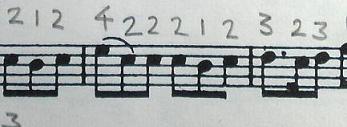
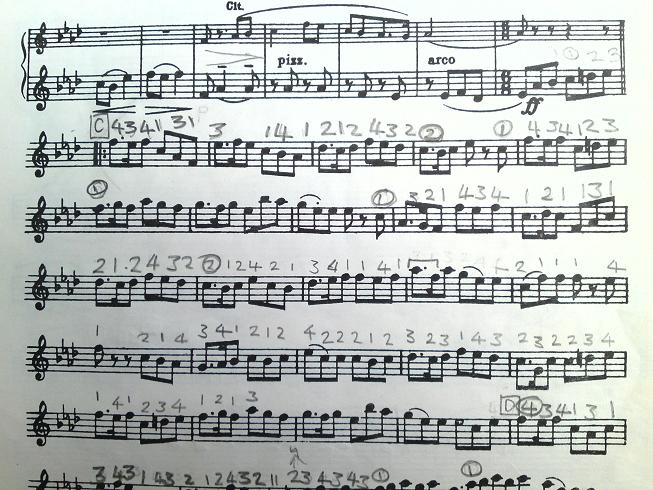
Part of a page of violin music, with fingerings written over virtually every note

And that’s what the music looked like after I’d started erasing the fingering.

You can learn a bit about the player by seeing what they’ve written in. This one had probably had a teacher who at some time stressed the importance of knowing what finger you’re going to use for every note in a piece, and of writing it in the music. And you certainly know precisely what finger they’re using for each note in the passage. Every single note. This is a player who follows their teacher’s instructions. Also a player, I think, who finds second position demanding but is nevertheless determined to use it where appropriate.

And in fact it’s good fingering: it works well, and is pretty much what I ended up using in the concert.

But actually, a part which has fingering written in like that is a nightmare to use. More on that in a moment.

Let me explain a little about basic violin fingering. In general (there are exceptions), it’s based on the concept of positions. These simply refer to how far up the neck of the violin the left hand is. For example, in first position your hand is next to the scroll, and your first finger plays the next note up from the open string. As you move up the scale, each next note up simply uses the next finger. For a semitone the fingers are close together; for a tone they’re further apart. When you run out of fingers, you move to the next string.) In second position, your hand is one note further up the violin. And so on.

So, as far as basic fingering goes, once your hand is in a given position, the fingers to be used are already known. Same note, same finger. And there’s definitely no need to do this:

“4 2 2 2 1 2″—once you’ve put your 4th finger down on the E, what other fingers could you possibly be using for those notes? And if you’ve got three identical notes in a row, is there really any doubt what finger you’d use for the second and third ones? The finger doesn’t even move—it just stays on the string for those three notes while the bow plays them. As far as the left hand is concerned, it’s just one note.

I think I understand what the player was doing. Many violinists have a great fear of playing in second position. I think that’s partly because it’s traditional to learn first and third positions before moving on to second. This makes second position quite a shock, because you’ve become used to the idea that odd-numbered fingers play on the lines and even-numbered fingers play in the spaces. With second position it’s the other way round, so it feels quite wrong and very confusing. And this particular player probably found it confusing for every note, so wrote the finger in for each one. Which I suppose is just about OK for purposes of slow practice. But for some reason they continued writing them all in, even when they were back in much friendlier first position.

Does this overkill matter? Well yes, actually.

When you read a piece of music, you’re taking in information. The more information there is, the harder that is to do. A finger for every note is simply too much to absorb, especially at speed. The redundant fingering gets in the way of reading the music. The stuff you don’t need to know (or rather, automatically know) conceals the stuff that’s important.

Occasional fingerings in the passage have been circled. Those are the position changes; the player presumably circled them to notice them and remember to do them. And the circling proves my point, really. They’re the ones that actually matter, and they were getting lost in the sea of redundant ones. For me, even the circling doesn’t help much: to read the fingering comfortably I need to get rid all the others. That lets me see where the position changes are and be ready for them. I can see that they’re coming up well before they arrive.

The other basic problem with filling the music with fingerings like that is that there’s no room to write anything else in. Bowings, for example. In this extract, there are several places where it’s crucial to know what bowing to use: the “4 2 2 2 1 2” bar is one such place. The slur in that bar means you’ve got to do something to avoid having “upside down” bowing in the next bar, and you need to mark just what it is that you’ll do.

What you should write in a part are the essentials: where to change position, what dynamic the conductor has asked for, little tricks of fingering that depart from what would happen automatically, whether a particular note is to be played as an open string or with the fourth finger, and so on. Bowings that depart from the instinctive ones. The less clutter there is in the part, the clearer your picture will be of what to do when playing. But also, the kinder you will be being to the next person to play from the part. They’ll be able to see what you did, rub it out if they don’t want it, and write their own essential markings during rehearsal without the stress of frantically erasing yours in the few seconds they have before playing resumes.

Why did people think the Sun went round the Earth?

Here’s something which puzzled me for a long time, until I happened to come across the answer a couple of years or so ago. I think the book Episodes from the Early History of Mathematics by Asger Aaboe (Cambridge University Press, 1997) provided me with the revelation, but I wouldn’t swear to it.

The puzzle

When people began watching the motions of the Sun, Moon and planets in the sky and measuring them properly—which happened many centuries ago—their movements turned out to be quite complicated, especially if you assumed (as most people did) that the Earth was stationary at the centre of the universe. Everything circled the Earth once a day, but with various wobbles superimposed on the motion.

This led to a rather unsatisfying and complicated picture involving epicycles, in which a planet’s motion in the sky was a combination of two or more movements: its circle around the Earth plus the various wobbles.

Before I go any further, let me point out that the the idea of a flat earth wouldn’t have entered into this: the realisation that the Earth was a sphere happened around 300 BC and Eratosthenes was the first to measure its size—with remarkable accuracy—in about 240 BC.

It was occasionally suggested that things might make more sense if actually everything went round the Sun, with the Earth rotating once a day. Yet, there was great resistance to that explanation. Why? What was the problem? Why not switch to the obvious answer? Why not just do it? Why was the “Copernican revolution” so revolutionary?

One reason was that Copernicus’ system, which based everything on combinations of perfectly circular movements, ended up being even more complex than what had gone before. But there’s another, very simple and logical reason.

The answer

If we look at the night sky we see the Moon, and lots of little points of light. Mostly these keep the same positions relative to each other, simply circling the North pole (or South pole if you’re south of the equator). They behave as though they’re attached to a rigid sphere, making them all rotate together. That was called the sphere of the fixed stars, and was thought of as the outermost part of the universe.

A few of them, though, seem not to be attached to it. They  move around according to  rules of their own, and were given spheres of their own to move them. But apart from that—and from not twinkling—they look pretty much the same as the other points of light. They just happen to be attached to their own spheres instead of the outer one.

How far away were the fixed stars?  Nobody knew, but they couldn’t really be much further away than the moving ones or they’d be too dim to see.

So far so good. But why can’t the Sun be at the centre instead of us? What difference would it make, apart from a little bit of wounded pride?

Putting the Sun at the centre of this picture creates a huge, glaring problem.

The closer you are to something, the bigger it looks. If the Earth went round the Sun, then any given constellation would change size in the sky as we moved towards and away from it. This would be clearly visible. Yet we don’t see it. And that, surely, proves that the Earth isn’t moving. It must be the Sun which moves around the Earth.

The revolution

So if you want the Sun at the centre, you have to explain why the fixed stars always stay the same distance apart in the sky. This entails making the sphere they’re attached to considerably bigger. And then you have to make them bright enough to see, so they’re not little twinkly things any more, but are like other suns in their own right.

But the Sun and its collection of spheres was the entire universe. Saying that the stars are really other suns is like saying that actually there are thousands of universes. It’s mind-boggling. It sounds somewhat insane.

It’s not a matter of demoting the Earth a little from its symbolic position as the centre around which everything revolves, and giving that honour instead to the Sun; it’s a matter of making both the Earth and the Sun utterly insignificant in the scheme of things.

Seen that way, the idea is indeed shocking.