I had to pass this on to you. I particularly like the last line. Shame about the spelling of snippet.
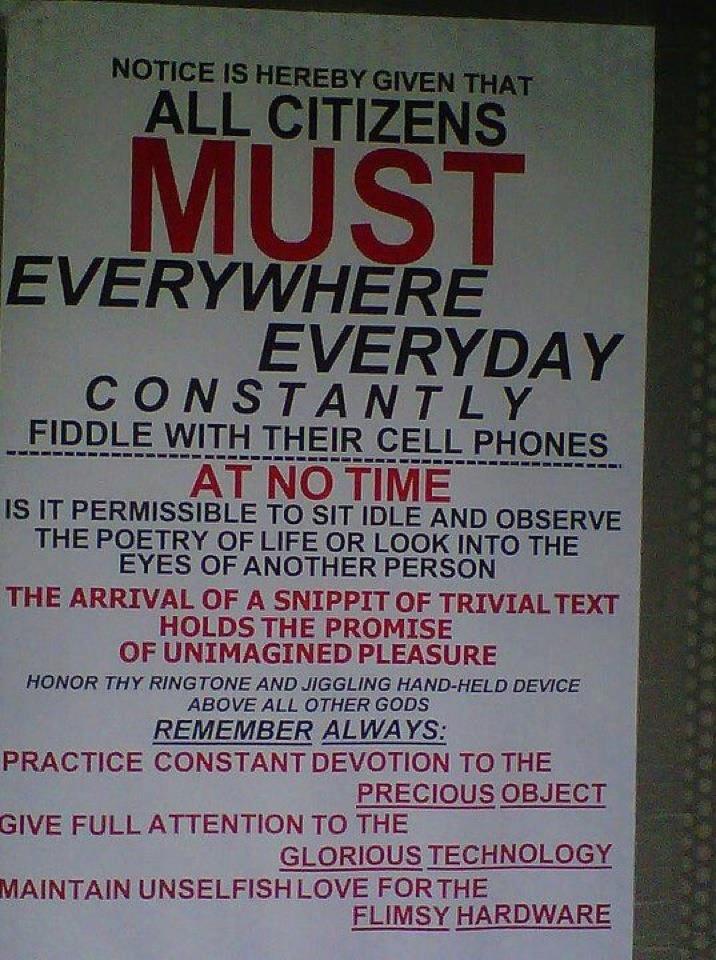
Seen on Twitter
Source: @SimonChapman6 on twitpic.com.

I had to pass this on to you. I particularly like the last line. Shame about the spelling of snippet.
Seen on Twitter
Source: @SimonChapman6 on twitpic.com.
All the books [1] seem to describe Norwegian, Danish and Swedish as “three mutually comprehensible languages”. This seems to be true for the written languages: for example I’ve had one or two conversations on Twitter where the other person uses Danish and I reply in Norwegian, and I’ve noticed that the Scandinavians routinely converse in this way. I need to ask about the odd word here and there, but mostly the words are so close to Norwegian that the meaning is obvious if I know the Norwegian word. The spellings are different and sometimes the meanings aren’t identical or the grammar looks wrong, but it’s comprehensible. Swedish is more of a challenge, but still often guessable given a bit of effort.
Apparently Norwegians find spoken Danish a lot less comprehensible, though. @Sandramogensen on Twitter [2] recently introduced me to this sketch from a Norwegian comedy show. You don’t need to know any Norwegian or Danish to watch it.
Just so you know, there’s next to no Norwegian or Danish in the video. The parts that sound as if they might be Danish are actually in Danish-sounding gibberish.
There’s is, however, a sentence which might be in Danish. I’m not 100% sure what the shopkeeper says in his final attempt to communicate with the customer. It’s one of these:
Those are both made entirely out of real words, but only the second is made out of real grammar. Vi forstår ingen ikke “translates” as something like “We not no understand”, while Vi forstår hinanden ikke is correct Danish and means “We don’t understand each other”.
I really want it to be the first one, since I think it makes the sketch funnier, but having listened a few more times I think it probably is hinanden rather than ingen.
I should probably also point out that kamelåså is an invented word. Google results for it lead either to the video or to pages talking about the video.
I’ve become aware of several things since writing this post nine months ago.
[1] The two or three I’ve looked at. Which may or may not be a representative sample.
[2] And also at http://www.sandramogensen.com
Not so long ago I wrote a post grumbling about the routine confusion among newsreaders between silicon and silicone. Silicon is the hard, shiny, brittle element used to make things like solar panels and microchips. Silicones are a huge range of silicon-containing compounds including oils, squishy plastics, and the gel used in breast implants. They’re as similar to silicon as cod liver oil is to diamond.
The other night I found myself talking online, in Norwegian, about silicone earplugs. The silicone they’re made of has a consistency somewhere between warmed-up beeswax and Blu-Tack. The problem I always have if I use wax earplugs overnight to keep noises out is that the wax is slippery and the earplugs tend to fall out too easily as a result. The silicone ones have a built-in stickiness, meaning that they stay in.
I wanted to recommend them to the person I was talking to. I also wanted to be sure that I was recommending silicone earplugs and not ones made out of silicon. Looking up silicone on EasyTrans (a site I use a lot for finding quick equivalents) took me to the Norwegian word silikon, which I only trusted 90%. So I looked up silicon, half expecting to see silikon again, but the translation shown was silisium. A quick check in Bokmålsordboka, the online dictionary run by the Norwegian Language Council, suggested that these were correct: it says that silikon is silisium-containing plastic. That’s not 100% accurate (not all silicones are plastics), but it’s the right way round. All silicones contain silicon.
Is Norwegian silikon the same term as English silicone, though? The easiest way to check this was to look in the Norwegian version of Wikipedia. Its entry on silicones confirmed for me that they are indeed the same. However, the section on terminology actually went so far as to include
I engelsk blir ofte «silicon» (norsk: silisium) og «silicone» (norsk: silikon) forvekslet, noe som skaper forvirring, selv om det ene er et grunnstoff og det andre er en kjemisk forbindelse.
which translates as
In English “silicon” (Norwegian: silisium) and “silicone” (Norwegian: silikon) are often mixed up, something which creates confusion, even though one is an element and the other is a chemical compound.
So there you are: English-speakers’ bad English is bad enough to be worthy of mention in a non-English Wikipedia article . . . (Though i engelsk looks a bit dodgy to me. Shouldn’t that be på engelsk?)
And it’s clear that silikon is one of those words one has to beware of because the English word they look equivalent to is in fact the wrong one. Related, but wrong.
Incidentally, something similar arises with this nice set of words which starts off looking equivalent to English but then goes somewhat haywire:
There’s a connection here with music practice, too. When learning a piece, you need to practice the obvious, easy parts as well as the difficult ones. Otherwise you can come a cropper in the concert when you suddenly forget which of the various obvious fingerings you were going to do, or discover that the note which was obviously an F sharp is actually an F natural and you’re the only one playing it as a sharp . . . Similarly in learning new words, it’s important to check that they mean what you think they do even if it seems obvious. Sometimes the obvious meaning is right, sometimes it’s wrong, and sometimes it’s just one of a range of meanings a word has. Often the other meanings aren’t obvious at all, but are ones which you want in your vocabulary because they’ll come in handy at some point.
Yesterday this tweet appeared from @hazelblackberry on Twitter.
””””””’ pic.twitter.com/pLtEn1gq
It led to this photo:
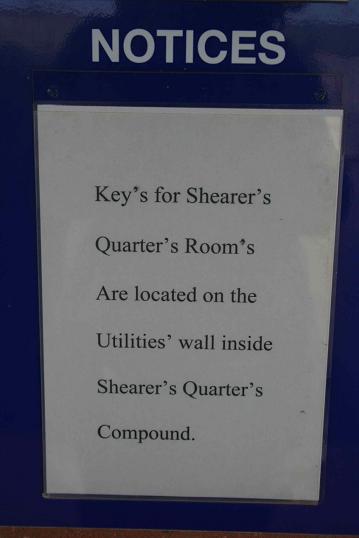
Used with permission..
What’s so wonderful about this is that every single apostrophe is wrong even in the words which should have one. That takes some doing. It’s slightly disappointing that there are two S’s and an s which don’t have apostrophes, but every s at the end of a word has one. [1]
Given this level of confusion, part of me is wondering whether one day something like this will happen:
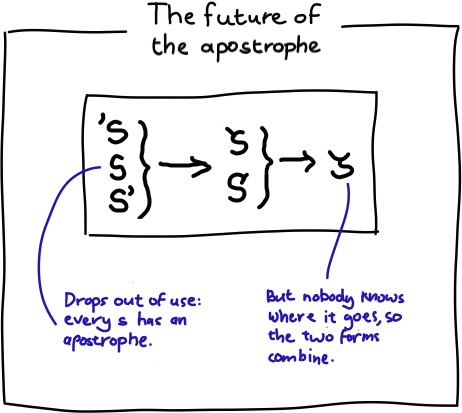
Since the letter s is always used with an apostrophe, the apostrophe becomes part of the letter. First there are two versions, depending on the placement of the apostrophe, but by this stage nobody can remember which is right anyway and it’s such a pain trying to choose between the two different s’s that the two forms merge.
Actually I suspect this won’t happen, since so much English is now typed rather than handwritten. More likely the apostrophe will go out of use unless the very straightforward rules for its use become widely known again. It’s an interesting thought, though. And drawing the illustration gave me an excuse to experiment a bit more with the graphics tablet that arrived the other day. 😉
[1] S’s as the plural of S is correct: letters of the alphabet are the sole exception to the rule that apostrophes never make plurals. Consider the other ways of doing it and you can see why. With no punctuation, the plurals of a, i and u would be as, is and us, which are virtually impossible not to read as the standard two-letter words. Try giving the a, i and u italics: as, is, us—almost as bad. Or putting them in single or double quotes: “a”s, “i”s, “u”s, ‘a’s, ‘i’s, ‘u’s. It’s hideously messy and looks rather strange. The simplest solution is a’s, i’s and u’s. If you regard the letters as being short for their spoken names, the apostrophe becomes logical for some letters: t’s is short for tees and z’s is short for zeds for example, with the apostrophe representing the omitted -ee- and -ed-.
Posted in language
Tagged alphabet, apostrophe, English, grammar, language, photos, speculation
Why I hate infinite scrolling has turned out to be quite a popular post. However, some people appear to both hate it and still have it turned on. So here’s how to turn it off if you’re one of them.
The instructions are for wordpress.com blogs, as of July 2012. They also get rid of the floating footer that follows readers down the page.

 The Other Blog Without A Name