
Science fiction is good for the brain

This post started life as a digression. I was trying to write a book review of Changing Planes by Ursula le Guin, but found myself thinking about this stuff and about a conversation I had a while ago. Hopefully the book review will follow soon, unless it spawns more digressions.

The conversation

A while ago, I was talking to an acquaintance about radio listening and about what kind of book we liked to read. She turned out to be a big fan of BBC Radio 4’s In Our Time, which considers the history of ideas and goes into each of its subjects in some depth. I like it too, but don’t often hear it as it clashes with rehearsals for one of my orchestras. It gets to grips properly with some very interesting subject matter. (If you want to hear for yourself, you can download the latest episode here.)

We both liked to read factual books–often science ones in my case. I said I don’t read very much fiction, and that when I do, it’s quite unusual for it to be set in the normal, everyday world. I tend to feel there’s quite enough reality happening to me already without inventing more of it. So I find myself reading books like Ella Minnow Pea (see my review), set in a world where letters of the alphabet have been banned, or Terry Pratchett’s Discworld series, where everything works (unreliably) by magic. The more inventive the better. (I generally hate crime fiction, since detective novels always seem to involve the same crime and story: murder committed, idiosyncratic detective solves puzzle, murderer caught, end of book. And there’s plenty of crime in the news already, which is quite depressing enough, thank you very much.)

Anyway my acquaintance said she couldn’t see the point of science fiction or fantasy and never read any. I think she saw it as merely escaping into a fantasy world disconnected from reality; it would be more interesting to get to grips with real issues about the real world. So she found it a bit silly, I think. Fairy tales for grown-ups, with no real content.

I was quite surprised, since that’s not how I see science fiction and fantasy at all. I pointed out that they’re all about exploring ideas, and that Terry Pratchett’s books are full of erudite references if you look for them…

What do science fiction and fantasy do?

There isn’t really a clear boundary between science fiction and fantasy. I suppose the best definition is to say that science fiction is generally set in a more technologically advanced version of this world, while fantasy lives in an entirely invented one. Or maybe, to suggest that if a science fiction book keeps annoying you because the science couldn’t work, you’d be better off thinking of it as fantasy… But the distinction doesn’t really matter here.

It seems to me that both genres use freedom of imagination to create freedom of thought. They do this by stretching or altering reality in some way. Yes, this can be done simply for purposes of entertainment and escapism, as in Doctor Who or Star Wars. But if you’re interested in ideas, creating an alternative reality can be an excellent way to explore them. This is particularly true for deeper ones about the nature of our existence, our humanity, or society and the world around us.

Albert Einstein’s thinking was a good example of this. He developed many of his ideas for the theory of relativity through what he called “thought experiments”. One of these involved imagining what it would be like to ride on a light wave. That’s impossible: nobody can ride a light ware, at the speed of light. But he explored it anyway, gaining deep insights into how the real world works. Einstein’s thought experiments were science fiction in miniature, and inventive science fiction at that.

An example in philosophy involves the use of a teleporting device. It works in the standard science fiction way: a person is disassembled into atoms at one end, and a perfect copy assembled at the other, complete with the same memories, personality etc. Is the person who comes out at the other end the one who went in? What if a copy is made but the original survives too–who is the real one? Why? We’re brought face to face with questions about consciousness and identity. What makes you you? What is a person?

Many things are so familiar to us that it’s hard to think clearly about them. We’re immersed in them. They’re the way they’ve always been. Our thoughts about them form a deeply-ingrained world-view: our society, our own nature, the world around us… It’s hard to notice the assumptions we make about these things and question them; we tend to think everything is the only way it can be.

What I think science fiction does is to create an alternative viewpoint from which we can stand back and see the world from outside in order to think about it more clearly. It does this in several ways:

  • Changing some important aspect of reality, in order to explore its nature or its significance to us.
  • Placing human beings in situations which can’t exist, to explore more deeply some aspect of human nature as they react to it.
  • Inventing a society or world-view very different from our own, in order to highlight our essential human values and why they matter to us.
  • Ditto, but in order to highlight and satirise our absurdities and stupidities and why we’d be better off without them.
  • Inventing a world in which some aspect of our behaviour or thinking is taken to the extreme, so as to explore the consequences and implications of that behaviour.

When we’ve got only our own reality, we’ve nothing to compare it with. When we’ve got an invented one too, the features of our own stand out and we can do some serious thinking about them and gain some real insights.

So good science fiction, far from being escapist, is actually a challenge: to explore freely with our minds, wherever the ideas lead, to be open to alternative ways of seeing the world, and to question and develop our own ideas about it. And that, I think, is well worthwhile.
Trying out WordPress

Well, here I am. Discovering that there are lots of useful settings I can set, which do all sorts of useful things, and that I don’t know where most of them are…

It looks pretty flexible, and I like that.

Hey, it saved my draft too, without me having to do anything. I approve of that, too.

Oo, password-protected posts! That’s a good idea too. Show people stuff without showing it everyone.

I don’t like the watery grey type. Doesn’t anyone use black ink any more? Let’s see…  Hmmm. Looks as though I can’t actually change the colour without creating a CSS. Why on earth use GREY as a default colour for text people might be going to READ?

Let’s try using the Font tag on it. Yes, that does seem to give me black text. Messy solution, but better.

Here’s a bit more outside the tag, just to check that the black bit really is a different colour from this and it’s not just my eyes going funny.

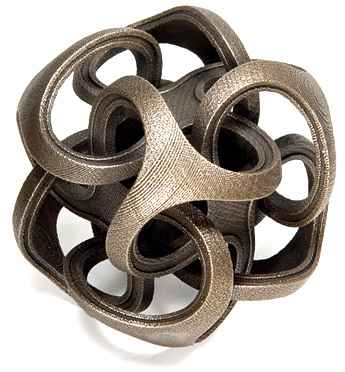
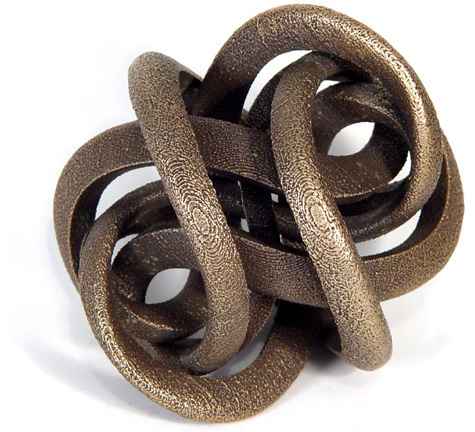
Amazing sculptures (or: what I want for Christmas)

Have you seen anything like this before?

Metatron

Metatron

I thought not. How about this?

Universal Clef

Universal Clef

These are the work of Bathsheba Grossman, who describes herself as “an artist exploring math and science in sculpture”.

My first reaction to seeing these and her other handheld sculptures was to want them. All of them.

They are beautiful, sometimes complex, and very satisfying. They seem to me to be what the artists who did Celtic knowtwork designs would have produced if they’d had three dimensions to work in and had seen M. C. Escher’s more geometrical drawings.

My second thought was that these shapes are impossible to make: imagine trying to carve one, or to produce a mould to cast one…

My third thought was that she had, however, made them. Otherwise she wouldn’t be offering them for sale. So off I went to her technique page to find out how on earth they’re done.

They are indeed impossible to make by traditional processes. Although Bathsheba will typically make a plasticine model as a starting point, the actual sculpture is produced by first using CAD software to define its precise shape, and then using 3-D printing process to make the actual object. This involves building the sculpture up layer by layer from powdered metal. A few more stages turn this into a solid metal sculpture.

To find out more about these and other works of hers, visit her website. Then buy one of each and send them to me for Christmas…

You’ll also find some remarkable internally-etched blocks of glass, containing such things as a genuinely 3-D map of our nearby stars… Beautiful stuff.

Notes

  • Photos used by permission. Do not re-use without linking to http://www.bathsheba.com and crediting the artist.
  • Bathsheba describes her glass pieces as “modelling three-dimensional data” and mentions here that she’s interested in suggestions for further such pieces–see her site for details.

Believing in God and in science: some beginnings

I was asked a while back to say something about my religious beliefs. It’s hard to know where to start, so I thought I’d start somewhere that’s particularly important to me and which relates to things I’ve already been blogging about…

A lot of people believe there’s a fundamental incompatibility between science and religious belief. I believe that they’re fundamentally wrong 😉

Is there a conflict?

There are scientists who reject religion. I suppose the most famous of these is Richard Dawkins, who has almost made attacking religion into a religion of his own. And there are religious people who reject science: for example those who treat the Bible utterly literally and insist that the world was created in six days as (supposedly) described in Genesis 1.

Cleearly there can be a genuine conflict. Someone who believes God does not exist, and someone who believes God created the world in six days, will never agree with each other. There is a fundamental disagreement between them. But is that the only kind of believer and the only kind of scientist? No–it’s an extreme variety of religion and only one kind of scientist. In fact there is no reason why scientific thinking has to reject God, or why religious belief has to reject the scientific understanding the earth’s history and of our origins. I think the debate typically takes place between people one of whom understands science but not religion, and the other understands religion but not science. And sometimes, I fear, there are religious people who don’t understand religion… though that might be a bit more contentious.

My starting point

In my first year at university, startled by my first encounter with biblical literalists, I made a conscious decision which I’ve followed ever since: anything which I believe as a consequence of my religion must be compatible with what I believe as a consequence of science.

There is only one reality, whether you’re looking at it through religious or scientific eyes. Science and religion both try to discover some truths about it. Truth can’t contradict itself; so if they do discover truth, it must be consistent. It’s no good to believe during the week that we eveolved by natural selection, only to believe on Sundays that we were specially created out of the blue 6,000 years ago. Science and religion must both live in the same real world. Theology and science must both adapt in response to known evidence, as we make more sense of the world we are in. Otherwise we’re disconnecting ourselves from the world and our beliefs are simply attractive ideas which have nothing to do with reality.

Do we want reality, or fantasy? I think that if we’re basing our lives on it, we should go for reality. Or at least, the closest we can get to reality.

Some misconceptions…

A number of misconceptions seem to be lurking in the background whenever science and religion come into conflict. So here are some things I don’tbelieve:

… about religion

  • Religion claims infallible truth
  • Religion is a set of beliefs
  • Scripture is an infallible, divinely dictated book containing those beliefs
  • All religious people see it that way, or should do
  • All religious people reject science and rational thinking
  • Faith is intellectual acceptance of [impossible] ideas despite evidence
  • Religious ideas are arbitrary.

… about science

  • Science claims infallible truth
  • Science works by proving things true
  • All true scientists are atheists and reject religion
  • Science is merely opinion
  • Scientists seek to control the world
  • Science starts out with a particular view of things, which it then seeks to justify in a biased way.

… about both

  • Religion and science are based on conflicting “facts” (e.g. the claim that the world was made 6,000 years ago, versus the scientific evidence that it is much older).

Sometimes some of the misconceptions are agreed on by both sides, and then the trouble starts. Copnsider a scientist and a Christian fundamentalist who both think it’s essential for a Christian to believe in six-day creation. They will argue forever over whether the world was created in six days. They’ll almost certainly never question the assumption that it’s an essential part of religion. So they’re doomed never to get anywhere…

Some definitions of my own

To answer all those misconceptions properly would turn this blog post into quite a long book chapter (last time I checked it was over 1500 words long as it is), so forgive me if I don’t do that in detail just yet. Instead, here are some attempted definitions which reflect my approach to it all:

Religion
Religion is the response of human beings to the divine.
Theology
Theology is the attempt to make sense of that response and produce a logically consistent set of ideas: about the encounter, and about what we’re encountering.
Science
Science is the attempt to make sense of the physical world by testing ideas against careful (ideally repeatable) observation.
The Bible
The Bible is a set of writings, accumulated over many centuries, providing a record of around two thousand years of religious experience and reflection on it. The experience was that of human nature encountering God and the world; the reflection is influenced by how writers at the time saw the world, and is expressed in many different genres.

It should be fairly obvious that the things on my Misconceptions List are incompatible with those ideas. I’m worried about the length of this post so I won’t go into that in detail now–maybe in another post if needed. Instead, here are

Some consequences

Religion as a response

What is a reasonable response to being loved by someone, or falling in love with them? Is it to come up with a set of rigid beliefs and theories about them, and put all your effort into intellectually accepting those theories? No–your response is “Wow!” or “I want to be with this person” or to love them back or to want to join in with their activities. Similarly with our response to God: it’s not a set of ideas, and it probably can’t even be put into words because God is so far beyond what our language can describe. But after a while we feel the need to understand what’s going on, and that’s where theology comes in, so we try to describe it anyway. The beliefs aren’t the starting point.

Similar and different

Theology and scientific theorising are in some ways very similar activities. Both try to make sense of human experience. In the case of science, this is the experience of doing certain experiments and getting certain results; in the case of religion, it’s our subjective, yet shared, experience of being conscious beings, of relating to the world, and of relating to what we perceive to be its creator. Science has a distinct advantage in its area, because it deals as much as it can with things which can be made objective and measurable and repeatable.

Yet science can’t handle God at all, for a very good reason. The only way we can experience God is subjectively, in our consciousness, within ourselves. Yet the whole idea of science is to remove everything subjective and personal as far as we can, in order to be objective and repeatable. It works by letting us stand back from what we are studying. (The physicist Schroedinger expressed this well; I’ll try to find the quote.)

I believe that good theology must behave in a similar way to good science. It must take account of the real world we live in, and the real evidence we see. Its job is to make sense of the world and our religious experience as they are, not as we say they should be. It’s not a matter of taking some pre-existing belief in, say, the infallibility of the Bible and forcing ourselves to believe all the consequences; it’s about taking what we see and experience and trying to fit it all together.

Also it seems clear to me that neither theology nor science is in a position to claim absolute knowledge of the truth. They’re each a search, hoping to get nearer to the truth as they progress. Both need humility and the willingness to change if a new piece of evidence comes in. Their “truths” are always provisional: the best we can come up with so far, but open to change and refinement.

The Bible

OK, this is the bit which you won’t like if you’re a fundamentalist…

What’s special about the Bible is not that “God wrote it”, but that it contains all those centuries of experience and reflection. Human nature is universal. God is universal. So, if the biblical writers encountered God, they encountered the same God we do. They sometimes interpreted the encounter differently from us; and sometimes had some odd ideas. For example a lot of the Old Testament assumes that God’s love for us must mean God hates our enemies and wants to wipe them out. The idea of God loving them too didn’t seem to occur to the writers. Yet even that horrible and blatantly unchristian idea came from the belief that the God they had encountered was a loving one. Just not one whose love extended to other people too… And certain aspects of the encounter are consistent through all those centuries of experience; we connect with them in our experience too.

This is all scene-setting, really. I’ve not even started on basic things like what sort of God I believe in! But I hope it helps you to see my starting point.

A plea

I know that if you’re a particular kind of atheist, or a fundamentalist Christian, you’ll disagree strongly with what I’ve written. That’s fine–but please respect what I’m doing here: I’m simply setting out my beliefs for some people who’ve asked about them, and I haven’t the energy to launch into heated debate. Gentle disagreement is OK though 🙂

Violin surprise

As I mentioned, I’ve not had as much energy for things lately. That has particularly included violin practice. I didn’t play at all between Dec 20th (my last concert before Christmas) and Jan 3rd (the day before what should have been my first rehearsal of 2009).

So when orchestra rehearsals started up again last week, I was expecting my playing to be rather rusty, and to have quite a lot of work to do to get myself going again. But something interesting had happened. Certain aspects of my technique–in particular, “bow contact” and string crossings–appeared to have significantly improved during the break, without me having done anything other than not practice.

Let me explain the history of my playing. When I began, around the age of 9, I was basically self-taught. This is not a good idea: lots of things have to be got right from the beginning in order to avoid problems later on. When I joined the school orchestra at 12 or 13, I started having lessons. Then at university I was able to have really good lessons, with a teacher who could show me how to set about undoing my numerous bad playing habits. And for the next “few” years I worked on doing that, with the help of various violinists from the past such as Carl Flesch (via his pair of books The Art of Violin Playing).

At the beginning of last year I had a few more lessons, with a view to taking a proper performance qualification (a diploma in violin performance). Plans for that were overtaken by events and I never took the exam, but I now had had some new aspects of technique to work on and continued doing so until June. Then came my father’s death, and several months of not really feeling like playing. The enthusiasm is just beginning to come back now.

My task before the lapse was to try to replace some old playing habits with new ones. Any player will tell you that if they don’t play for a while, when they start up again they feel as though their bodies have “forgotten” how to play. For example, you send instructions to your fingers and they don’t respond properly. What seems so have happened in my case, though, is that the break has helped my body to forget the old aspects of my playing which I was trying to get rid of anyway, and what has come back is the new version which I was working towards. It was a very nice surprise, and completely unexpected. It’s as though working on my new playing style is a move vivid memory than using the old one. It really has become a lot easier to play in the way I was aiming for.

I’d be interested to hear from anyone else who’d had a similar experience of several weeks’ non-playing helping them to improve.