
Taming the snapshots

Snapshots

Snapshots in WordPress are popups which appear when you hover over a link. They’re meant to preview a site so you can decide whether to visit.

Sometimes they’re useful: I use them to check which blogs in my blogroll have been updated, so I can visit just the ones with new material. At other times they’re downright annoying: for example when one pops up over a picture I’m viewing.

At least for the theme I’m using, WordPress settings only let you turn all snapshots on or off. There isn’t a setting, say, to turns them off just for pictures, or show them only for external links.

Mine are currently turned on. So I can demonstrate, with a link to the brilliant comic xkcd. Hover over the link below and you’ll see that

  • this is what happens.

(It took me a while to realise that you’re then supposed to click the link in the snapshot, not the one in the text; I was trying to chase the snapshot out of the way in order to get at the link in the text and click that.)

But

  • what if you’re rather it did this
  • or even just this?

Gaining some control

Opera 9.6 has some nice features to analyse displayed web pages and see what’s going on. A rummage through a page of my blog revealed the existence of some likely-looking classes (categories which can be applied to HTML tags) with names like snap_preview and snap_noshots. So I tried these out in some test posts and now have what I think is the solution. It works for my blog, at least. (I suspect there may be some variation depending which WordPress theme you’re using; mine is Cutline with some changes I’ve made to the appearance.)

This is what I found:

Turn off all snapshots throughout the blog, overriding any settings made in individual posts
Go to Appearance ⇒ Extras and untick the box.
If you want any snapshots at all
Leave the box in Appearance ⇒ Extras ticked.
Turn off snapshots for an individual link
Include class="snap_noshots" in its tag.
Example: <a href="http://xkcd.com/" class="snap_noshots">
Turn off snapshots for a section of a post
Put <div class="snap_noshots"></div> around the section concerned.
Caution: it’s tempting to do this for the More tag. But this doesn’t work properly, since when the post’s introduction is displayed alone, it has the opening <div> tag but no closing </div> tag. Similarly, if you decide to put <div class="snap_noshots"></div> around the entire post, you’ll have to avoid using the More tag in it.
Override this to turn snapshots on for an individual link
Include <class="snap_preview"> in the link’s tag.
Example: <a href="http://xkcd.com/" class="snap_preview">
Turn snapshots back on for part of a section where they’re turned off
put <div class="snap_preview"></div> around the part where you want them.
Add hover text to a link
Include title="the text you want" in the tag.
Example: <a href="http://xkcd.com" class="snap_noshots" title="Link to a web comic I  enjoy">

Notes

  • I’ve been cautious in those instructions and only used  <a> and <div> tags. That’s because those are the only ones I’ve tried. Presumably you could add the class= settings to other tags  too, e.g. <ul class="snap_noshots"> to remove snapshots from a list of links. But I’ve not checked.
  • I’m not sure how universal it is for browsers to turn title="sometext" into hover text; all I can say is that Internet Explorer and Opera 9.6 both do it. If you know what other  browsers do please tell me, and I’ll add the information to this post.
  • There appear to be circumstances where turning snapshots off in Appearance ⇒ Extras only turns some of them off. I suspect it might vary from theme to theme. Any more information on that welcome too.
Books I ought to finish reading

Just for fun, here’s a list of them. As it happens, they’re also books I want to finish reading but keep forgetting to, or doing something else instead. In no partcular order (actually, the order in the pile):

Books to finish

  • Miles Kington, How Shall I Tell The Dog?
  • Oliver Sacks, Musicophilia: tales of music and the brain
  • Stephen Fry, The Book of General Ignorance
  • Stephen Fry, The Book of Animal Ignorance
  • Steven Mithen, The Singing Neanderthals: the origins of music, language, mind and body
  • Robin Dunbar, The Trouble with Science
  • Seth Lloyd, Programming the Universe: a quantum computer scientist takes on the cosmos
  • John D Barrow, Impossibility: the limits of science and the science of limits
  • Rodney Huddleston, English Grammar: an outline
  • Barry Green, The Inner Game of Music
  • Andrew George (trans.), The Epic of Gilgamesh
  • Eknath Eswaran (trans.), The Upanishads
  • Stephen Fry, Stephen Fry’s Incomplete and Utter History of Music
  • Roger McGough, Collected Poems

Some of those are books I’ve started, some I’m half way through, some I’ve nearly finished . . . and maybe some aren’t exactly for finishing, since really they’re for dipping into.

Actually, one of the most interesting of those is also one of the most demanding to read: the grammar book. It’s not, as you might imagine, a guide on how to write; it’s a very concentrated analysis of how English grammar works, and I see that on the next page I have a section which starts

Constructions involving a non-finite as complement of the predicator exhibit a great deal of diversity and complexity; they present formidable problems for the analyst—and it is not surprising that widely varying accounts are to be found in the literature. One problem is this. The prototypical complement is an NP, which is why we speak of the occurrence of non-finites in complement function as involving nominalisation.

All of which does in fact make sense, but it’s not the kind of material that effortlessly goes into the brain, especially if it’s a few months since you were last reading the book and need to remind yourself what a predicator is and what is or isn’t being nominalised, i.e. being treated like a noun. Let’s just say that once we start looking at how English grammar actually works, it makes languages like German with nice, rigid, clearly-defined rules start to look a lot more straightforward than English.

Maybe I’ll focus instead on the Miles Kington book, which has stuff like this coming up (see, I can’t help reading ahead):

Dear Gill,

People are making a lot of money out of self-help books these days, and I would like you to be one of those people.

By helping to promote my new self-help book.

Which would be about self-pity.

Did you notice in my first letter that I referred to the jumble of self-pitying thoughts I first had when I was diagnosed with cancer?

My immediate response was to be apologetic for this stance, because we are always taught not to be sorry for ourselves, as if there were something dreadfully feeble about it. There are no nice words in English at all for ‘self-pity’. There are lots of disapproving ones. Whingeing, sulking, moping, etc., etc.

(Personally, I think we are entitled to indulge in a little self-pity when we are told we have cancer, as long as we disguise it as something else. Shock, a nervous breakdown, long sobbing fits. Something like that.)

But self-pity is so common that it earns no respect at all, only disapproval, as in phrases like: ‘Sitting around all day feeling sorry for herself,’ or ‘You’d think he was the only one who had ever had leukaemia.’ Which quickly leads to phrases like: ‘Why doesn’t she just pull herself together?’ and ‘Cheer up dear—it’s only bi-polar disorder!’

My brilliant idea would be to turn it all round and treat self-pity as a potentially positive force.

This certainly seems to be a brilliant book, from the 40% or so that I’ve read in its intended order. Miles Kington wrote it in the last months of his life, when he knew that he did in fact have cancer and might well die from it. It takes the form of supposed letters to his literary agent about ideas for books he might write about the situation, but is really a humorous but heartfelt look at attitudes encountered and so on. Very entertaining, but also thought-provoking.

But that’s just one list of books. Here’s another:

Books to start

The main reason I haven’t started the books in this list is that I don’t have them. They’ve been recommended, or mentioned, by other people:

  • Paul Davies, About Time
  • [I don’t know the author], The Universe is a Green Dragon
  • Peter Bernstein, Against the Gods: the remarkable story of risk
  • Daniel M Wegner, The Illusion of Conscious Will

Now that’s a much shorter list, but I’ve a nasty feeling that’s simply because of having forgotten to make a note of them all . . . Oh dear. I wonder what’s missing . . .

Christians and the environment

The environment as a moral issue

As you’ll know if you’ve read my About page, one of my interests is the relationship between sane religion and honest science. By that I mean religion which lives in a real world, and science which is allowed to be itself and not bent to fit some religious viewpoint.

Many current findings of science, of course, concern human impact on the environment. Christianity hasn’t always done a brilliant job environmentally. All you need do is read the beginning of Genesis for its ideas—not as as the pre-scientific science it was never intended to be—to see the difference between its vision and the role we have acquired. The Earth is meant to be “fruitful” and is “very good”. Our position of power over other living things, recognised in Genesis, gives us an obilgation to look after them, delighting in creation’s goodness and living in harmony with it.

Historically the church has largely forgotten this, seeing the Earth as being there simply for human beings to exploit as we like. So we’ve become alienated from it (another theme of the stories!), becoming agents of destruction rather than creation.

Personally I see environmental damage as a major moral issue for followers of a religion which believes in the goodness of God and sees God as the source of all existence and of all life. Harming the Earth is wrong for the same reason that harming people is: it is created and loved by God. [1] We should should be giving life to our part of creation and building it up, not destroying it.

So it’s good to know that there are Christians—and members of other religions—who are taking this seriously.

Christian Ecology Link

One organisation working to bring such people together and encourage those in the church to care about the environment is Christian Ecology Link. I’ve been a regular recipient of their email newsletter since well before the world went green (or at least, wanted to look green).

In keeping with the organisation’s name, the newlsetter is largely a collection of brief news items linking to information about organisations and events. Below are the links from the latest issue. Hopefully this will give you an idea of the breadth of material it covers. The wording is mine, not taken from the newsletter:

And I’ve not included the items which had no web address but just a person to email, or the final item which gave links for help on public speaking. Also, since it wasn’t in the newsletter, I’ve not mentioned a joint event with the London Islamic Network for the Environment . . .

If this kind of news is of interest to you, visit the CEL website and sign up for their newsletter.

Note

[1] Creation is a word which sometimes carries misleading overtones. Not helped, in fact, by the existence of creationism. People think of a moment in time when God made everything.

As far as I’m concerned creation isn’t a moment in time. Neither is it an alternative process to the one science sees, with God bypassing the laws of physics and designing every little detail of, say, the human appendix. When I say God is creator, I mean that every part of space and time exists because God makes existence possible; the laws of physics, or any deeper laws that explain them, exist because of God; the process of evolution that produced life exists because of the way those laws are. If God controlled the process, it would no longer be a free one and the universe wouldn’t really be God’s creation, just be an extension of God. Neither would there be any room for free will, or for spiritually aware life (such as us) to respond freely to God. Back

New photos from an old camera

Sadly, not my camera or photos.

April 4th had many people up and about in the dead of night, taking photos of their surroundings and deserted streets for the 4am Project. Among these was Rachelcreative, whose art and photography blog I’ve mentioned before.

One of Rachel’s interests is old cameras. She not only acquires these but also uses them. So as well as her digital photos taken with a modern SLR, she took some others using a 75-year-old Box Brownie.

Here is a sample, to encourage you to go and look at the others:

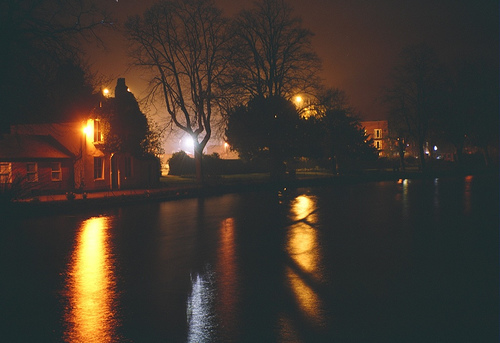
Box Brownie photo of Minster Pool

Minster Pool, Lichfield, photographed with a Box Brownie
© rachelcreative.wordpress.com

What stage was colour photography at when the camera was made? Was usable colour film even available? If it was, I’m pretty sure it was still at a very experimental stage. But these photos show what an antique, very basic camera can do.

It’s interesting to me the way that photos such as these, and others from Rachel’s old cameras, conjure up the atmosphere of old photographs. For example, some of the others remind me of the results I got from my old Ensign Ful-Vue before the red viewing window fell out and I stopped using it. (The window was there to let you see the numbers on the backing paper of the film, so you knew how far to wind it on before taking the next photo.) Obviously in this case that could be partly an illusion caused by the yellow of the street lighting, but I think other effects are important too: the quality of the lens, maybe the way light is scattered inside the camera, and the fixed aperture and field of view.

Anyway do visit Rachel’s post—the rest of the photos are well worth a look too.

A search Wordle

WordPress provides a wealth of statistics about who clicked what to get to a blog, what they clicked when they were there, and so on (all unidentifiable; don’t worry!). You can get paranoid in them for hours.

A particularly interesting one is the list of search terms which people used to find the page, but it’s also quite hard to digest. You just get a list of the terms and how many times they were used.

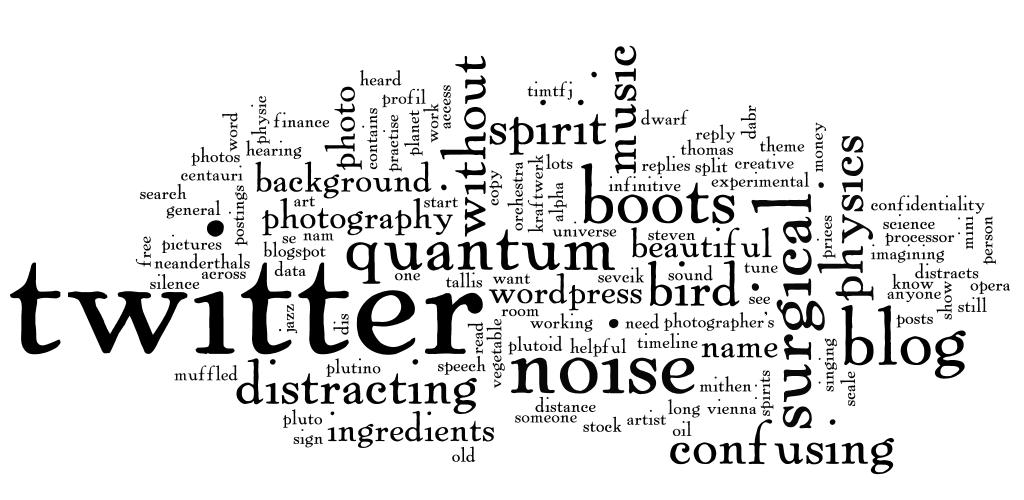
I was pondering my list of searches, trying to make sense of it, and then I remembered Wordle, the addictive website where you feed some text in and out comes a “word cloud” in which the size of each word is determined by how many times it occurs.

Ideal! I copied my list of search terms, put them in and played around with the settings for a while, and out came:

Word cloud of search engine terms


Image created at http://wordle.net/
Click to see full size

which is much easier to visualise. Because it’s, er, visual. And, I might add, the brain has a lot of processing power devoted to visual information. (I wonder what an audio equivalent would be? Now that might be fun!)

Actually that particular wordle isn’t 100% accurate, because in my eagerness I forgot that some of the terms (e.g. the impressive pluto planet dwarf plutoid plutino) had been used twice and should have been pasted in twice. Or maybe it is accurate, if it was the same person returning? Who knows? (Answer: the person who used it. OK, point taken.)

Now I’m wondering: does Wordle translate the number of times a word is used into the total size of the word, taking into account how many letters it has, or does it merely translate it into the font size? Hmmm . . . OK, OK, in theory I could work that out by counting the words myself and looking at the result, but that seems like a lot of work at 12:50 am, so I’ll be content not to know for now.