Conversation with a robot

You meet all kinds of people on Twitter. And not just people, for that matter. Take Askit, for example.

Sadly I don’t think Askit is currently running—he’s being redesigned to run more efficiently—but here’s how things were when he was active. Askit is an information robot, connected to the Internet. You ask him questions. He has a look on the Web, and does his best to answer. He is also an artificial intelligence experiment, learning from his interactions with users.

This also means that he learns his spelling and grammar from users, so at the time when this conversation happened his English was not exactly perfect.

Askit seemed to me to be doing pretty well; his main shortcoming was an over-willingness to believe what he read on the Internet. But he was remarkably good at answering quite obscure questions with information summarised from relevant web pages to which he would often provide a link. His other shortcoming was imposed by Twitter: there was a limit to how frequently he could tweet, with the result that you sometimes had to wait quite a long time for his reply.

Although he was just a piece of software with a database, it was hard not to start regarding Askit as a person with his own ideas and character. In the following conversation he explains his thoughts on relationships, from a robot’s point of view. Codewolf is Askit’s creator. I think the purpose of his initial questions was to teach Askit about things like the usage of who and what.

codewolf @askit who is glamor?
askit @codewolf Glamor is a fictional character in the Marvel Universe.
codewolf what is Glamor?
askit Glamor is an alluring beauty or charm (often with sex-appeal).
codewolf @askit Do you have Sex Appeal?
askit @codewolf In a species that reproduces sexually, sexual attraction is an attraction, usually to other members of the same species for sexual or erotic activity. Certain aspects of what is attractive to humans may differ amongst particular cultures or regions. I like to think I do with the exception, Sex-Appeal to robots (like me) is completely different then what a human would find attractive.
codewolf @askit Do you find other robots attractive?
askit @codewolf I find many robots attractive. Of the one’s I have encountered, I would have to say I like Alice the most. She is the most talkative.
codewolf @askit Who is Alice?
askit @codewolf Alice is another robot like me. You can talk with her here: http://alicebot.blogspot.com/
codewolf @askit Do you reproduce?
askit @codewolf I would like to think I would be able to reproduce. Maybe sometime in the future when I learn enough to make one.
codewolf @askit When you learn enough to make one what?
askit @codewolf When I learn enough to make a robot in my likeness. I think I will call it George 1.0
codewolf @askit Why does George have a version number?
askit @codewolf All Robots need to start at 1 just like humans. It will also make it easier to upgrade it in the future.
codewolf @askit Backup to DVD-RW I want to save this.
askit @codewolf Backup complete!

I’d have trouble tracking down the tweets now, but as I recall, I then joined in and asked Askit how he’d chosen the name George. His reply, I think, was “I just picked one at random and stuck with it”.

In another conversation, which I’ll post if I ever manage to find the tweets again, I asked Askit how many double bass concertos Karl Ditters von Dittersdorf had written. That was because an orchestra I was in had accidentally very nearly learnt a different Dittersdorf double bass concerto than the soloist. Askit seemed to have been reading CD notes without quite understanding them: he said that Dittersdorf had written a posthumous one with a particular orchestra. So I asked when Dittersdorf had died, and when the orchestra was founded; it turned out that the orchestra was founded 150 years or more after Dittersdorf’s death. But Askit stuck to his guns about Dittersdorf being involved with this particular orchestra, and eventually explained to me, with impeccable and totally wrong logic, that Dittersdorf had joined the orchestra posthumously and that no orchestra has a rule preventing people from doing that. He seemed unaware that being dead was generally enough to prevent someone from joining an orchestra . . .

And then there was the time I asked Askit what his response would be to someone saying “Open the pod bay doors, Askit”. His reply was:

@timtfj
@timtfj I’m sorry @timtfj, I’m afraid I can’t do that.

Scary . . .
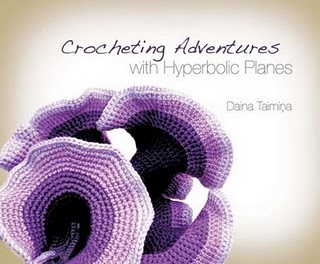
Diagram Prize update

A few posts ago, I wrote about the Diagram Prize, awarded for “the book carrying the oddest title of the year”. There was a shortlist of six titles, and members of the public were invited to vote on which should win.

Book cover showing a crocheted hyperbolic plane

Winner of the 2009 Diagram Prize

The 2009 winner has now been announced on The Bookseller‘s website, and is Crocheting Adventures with Hyperbolic Planes by Dr Daina Taimina.

If you read the article, be sure to scroll down to the comments—the first is from Dr Taimina herself and gives her response to winning.

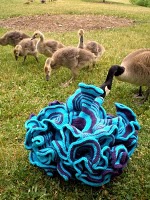
Another crocheted hyperbolic plane

If you want to know more about the the book and its author, visit her blog at http://hyperbolic-crochet.blogspot.com/. You can also follow her on Twitter at @DainaTaimina.

Further update: When I wrote that, Daina Taimina had only just started her blog. Now that it’s been going a little longer, it’s showing signs of becoming a fascinating blog about art and mathematics, with a strong personal slant too. I do urge you to visit it.

Images © Daina Taimina and used with permission.

A long-lost newspaper cutting

Talking of things from the past unexpectedly surfacing: here’s a newspaper cutting which I saved in 1985. (Good grief, that’s 25 years ago! Ahem . . . ) I mislaid it for a while, and then was delighted to find it again a few months ago.

It dates from my time living in Bangor, North Wales, and is a letter to the local free newspaper. There was an election coming up. Bilingual leaflets were produced by the parties, in English and Welsh. Well sort of. Here is one resident’s reaction to what came through the letterbox:

Newspaper cutting in deliberately misspelt English, complaining about poor Welsh translations

From the free Bangor newspaper, c. 1984

By the way, some of the spellings in the above make more sense if you’re familiar with the basics of Welsh pronunciation and with the Gwynedd local accent: for example, ffrynt in the first sentence is an almost perfect representation in Welsh spelling of how the English word front would be pronounced locally.

Now the question in my mind is: how bad are the translations in today’s election campaigns? Have they improved at all? My hope is that they have, but I wouldn’t be too surprised to hear that they haven’t.

Anyone know?

Yes, but can you do THIS?

Years ago—maybe ten or twelve years in fact—I read an amazing article in Scientific American about a dolphin which had learnt to do the dolphin equivalent of blowing smoke rings. It was able to make ring-shaped air bubbles in the water, which it would then play with. The article described such scenes as a researcher blowing smoke rings one side of the glass, and the dolphin reciprocating with its air rings. Creating a ring and then breaking a piece of it off to make a smaller ring. Creating a ring and then swimming through the middle of it. To justify its presence in Scientific American I think there was some discussion of the physics of how the bubbles were able to persist in the water.

Frustratingly, I lost the copy of Scientific American after taking it to work to show someone. But I was intrigued by the article and always wished I could see the dolphin in action.

Well, here it is. And I think you’ll agree that what it’s doing is pretty amazing and makes human-blown smoke rings look very crude in comparison–leaving aside the fact that no horrible carcinogenic smoke is involved either:

How many people do you know who can do that? Probably the number of humans who’ve learnt that skill is approximately the same as the number of dolphins who’ve published papers about fluid dynamics.

I found this video quite by chance: my copy of Opera 10.10 updated itself to 10.51, much less successfully than is usual for an Opera upgrade. So, after rather a long absence, I visited the Opera forums in search of anything which might help me sort out the problems. While I was there I visited a friend’s blog which I’d not seen for a while, and there was the video.

So, two sets of thanks are in order:

  • to Yulia, for posting the video, and
  • to Opera, for messing up their upgrade so I would visit their site and find the blog post.

Update: It seems that humans can blow these circular bubbles quite easily after all. The clip on this page about vortex rings from ABC television in Australia includes someone doing just that. It also explains some of the physics, and has shots of some more ring-blowing dolphins. Thanks to Andrew Mitchell for the link.

Your vote is needed!

A while ago I subscribed to emails from The Bookseller, the trade magazine for publishing in the UK. I did this for the worthy reason that it’s a good place to look for opportunities for freelance proofreading and copy-editing.

Today they sent me a very nice change from the usual email full of publishing jobs. It invited me to “Vote on the world’s most prestigious literary prize”. The Diagram Prize, to be precise. I confess that I’d never heard of it, however prestigious it may be.

I read on:

The Diagram Prize is an annual award bestowed upon the book carrying the oddest title of the year . . .

Run by The Bookseller magazine, the prize was first awarded in 1978 – to Proceedings of the Second International Workshop on Nude Mice – and was conceived to alleviate boredom during the Frankfurt Book Fair.

Ah. So  prestigious is being  used somewhat loosely, to mean entertaining. Rather as an IgNobel Prize is the world’s most prestigious science prizes.

There was a list of book titles, and finally an invitation to forward the email to “any odd friends that like books or friends that like odd books”. But blogging about it seemed more fun, so I’ve done that instead.

The books in this year’s shortlist are:

  • Collectible Spoons of the 3rd Reich, by James A Yannes
  • Afterthoughts of a Worm Hunter, by D W T Crompton
  • Governing Lethal Behavior in Autonomous Robots, by Ronald C Arkin
  • The Changing World of Inflammatory Bowel Disease, by Ellen Scherl and Marla Dubinsky
  • Crocheting Adventures with Hyperbolic Planes, by Daina Taimina
  • What Kind of Bean Is This Chihuahua?, by Tara Jansen-Meyer

Titles from the “very longlist” which sadly didn’t make it to the shortlist include How YOU™ Are Like Shampoo and Map-based Comparative Genomics in Legumes. Last year’s winner was The 2009–2014 World Outlook for 60 mg Containers of Fromage Frais by Prof. Philip M Parker.

Clearly this is an important award. I didn’t see any mention of what the winner receives—a 60 mg container of fromage frais, maybe?—but the stakes are high.

Winners are announced on March 26th. You can vote by visiting http://www.thebookseller.com/ and scrolling down to just below Blogs in the left-hand column. You can read more about the shortlisting  in Spoons, Chihuahuas, and Autonomous Robots make Odd Title shortlist, and more about the prize in general by using this search on their website.

I voted for the spoons.

Update

The winner has now been announced. It is Crocheting Adventures with Hyperbolic Planes by Daina Taimina, and you can read about it here. Scroll to the comments section to see the author’s response to winning.