
Tag Archives: humour

How to make coffee without losing friends

You’ve probably noticed two trends in the instruction manuals or leaflets which come with consumer items. For one groups of items—mobile phones for example—the trend is towards giving less and less useful information. For example, my new phone has a red light on the side which sometimes flashes. It must do this for a reason, to indicate something, but I’ve no idea what and the manual doesn’t tell me. In fact much of the manual consists of sentences beginning “You can . . .” which mention a particular task but don’t actually mention how to do it.

The other trend is towards giving more and more unnecessary information—for example, telling you that candles burn and that the flame is hot.

Many sets of instructions are also written in barely intelligible English, translated from another language by a non-native speaker of English. Personally I think such translations should be required to meet a minimum legal standard, since confusion can in some cases be dangerous and in others can make certain features of a product unusable. If the instructions for a feature can’t be deciphered, then the feature is effectively not there and you may just as well have been sold a faulty product.

A couple of weeks ago I bought myself a Russell Hobbs coffee grinder, in order to let me drink nice, freshly ground coffee. It works very well.

My first reaction to the instructions that came with it was that it was a breath of fresh air to read ones which were obviously written by someone who knew English. Every word was intelligible.

My second thought was that they were rather detailed, but since a lot of the detail concerned safety and the reasons for various things, that was still OK.

What I wasn’t expecting, though, was the advice on personal relationships in step 20:
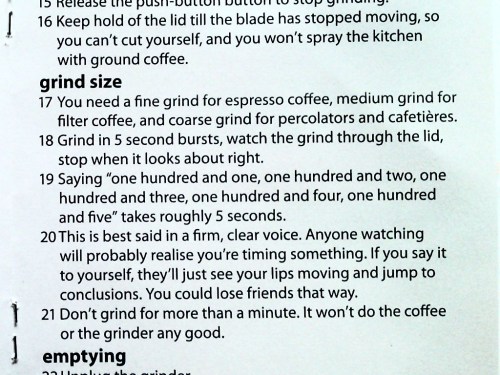
Extract from Russell Hobbs instruction manual

Item 16 is reasonable, though amusingly worded. So are items 17 and 18, though the writer appears either not to have heard of semicolons or to have missed an and out. Item 19 is certainly an adequate way of counting approximate seconds. But item 20???

That made me laugh out loud, but I’m wondering how on earth it made its way into an actual instruction booklet. In a draft as a joke when someone had been drinking, maybe . . . but the final booklet? For a well-known manufacturer? Do they know what is going out in their name?

I confess that when I grind the coffee, I don’t count in a “firm, clear voice”. I either time the bursts with my watch, or count quietly and take the risk of people jumping to conclusions.

Books I ought to finish reading

Just for fun, here’s a list of them. As it happens, they’re also books I want to finish reading but keep forgetting to, or doing something else instead. In no partcular order (actually, the order in the pile):

Books to finish

  • Miles Kington, How Shall I Tell The Dog?
  • Oliver Sacks, Musicophilia: tales of music and the brain
  • Stephen Fry, The Book of General Ignorance
  • Stephen Fry, The Book of Animal Ignorance
  • Steven Mithen, The Singing Neanderthals: the origins of music, language, mind and body
  • Robin Dunbar, The Trouble with Science
  • Seth Lloyd, Programming the Universe: a quantum computer scientist takes on the cosmos
  • John D Barrow, Impossibility: the limits of science and the science of limits
  • Rodney Huddleston, English Grammar: an outline
  • Barry Green, The Inner Game of Music
  • Andrew George (trans.), The Epic of Gilgamesh
  • Eknath Eswaran (trans.), The Upanishads
  • Stephen Fry, Stephen Fry’s Incomplete and Utter History of Music
  • Roger McGough, Collected Poems

Some of those are books I’ve started, some I’m half way through, some I’ve nearly finished . . . and maybe some aren’t exactly for finishing, since really they’re for dipping into.

Actually, one of the most interesting of those is also one of the most demanding to read: the grammar book. It’s not, as you might imagine, a guide on how to write; it’s a very concentrated analysis of how English grammar works, and I see that on the next page I have a section which starts

Constructions involving a non-finite as complement of the predicator exhibit a great deal of diversity and complexity; they present formidable problems for the analyst—and it is not surprising that widely varying accounts are to be found in the literature. One problem is this. The prototypical complement is an NP, which is why we speak of the occurrence of non-finites in complement function as involving nominalisation.

All of which does in fact make sense, but it’s not the kind of material that effortlessly goes into the brain, especially if it’s a few months since you were last reading the book and need to remind yourself what a predicator is and what is or isn’t being nominalised, i.e. being treated like a noun. Let’s just say that once we start looking at how English grammar actually works, it makes languages like German with nice, rigid, clearly-defined rules start to look a lot more straightforward than English.

Maybe I’ll focus instead on the Miles Kington book, which has stuff like this coming up (see, I can’t help reading ahead):

Dear Gill,

People are making a lot of money out of self-help books these days, and I would like you to be one of those people.

By helping to promote my new self-help book.

Which would be about self-pity.

Did you notice in my first letter that I referred to the jumble of self-pitying thoughts I first had when I was diagnosed with cancer?

My immediate response was to be apologetic for this stance, because we are always taught not to be sorry for ourselves, as if there were something dreadfully feeble about it. There are no nice words in English at all for ‘self-pity’. There are lots of disapproving ones. Whingeing, sulking, moping, etc., etc.

(Personally, I think we are entitled to indulge in a little self-pity when we are told we have cancer, as long as we disguise it as something else. Shock, a nervous breakdown, long sobbing fits. Something like that.)

But self-pity is so common that it earns no respect at all, only disapproval, as in phrases like: ‘Sitting around all day feeling sorry for herself,’ or ‘You’d think he was the only one who had ever had leukaemia.’ Which quickly leads to phrases like: ‘Why doesn’t she just pull herself together?’ and ‘Cheer up dear—it’s only bi-polar disorder!’

My brilliant idea would be to turn it all round and treat self-pity as a potentially positive force.

This certainly seems to be a brilliant book, from the 40% or so that I’ve read in its intended order. Miles Kington wrote it in the last months of his life, when he knew that he did in fact have cancer and might well die from it. It takes the form of supposed letters to his literary agent about ideas for books he might write about the situation, but is really a humorous but heartfelt look at attitudes encountered and so on. Very entertaining, but also thought-provoking.

But that’s just one list of books. Here’s another:

Books to start

The main reason I haven’t started the books in this list is that I don’t have them. They’ve been recommended, or mentioned, by other people:

  • Paul Davies, About Time
  • [I don’t know the author], The Universe is a Green Dragon
  • Peter Bernstein, Against the Gods: the remarkable story of risk
  • Daniel M Wegner, The Illusion of Conscious Will

Now that’s a much shorter list, but I’ve a nasty feeling that’s simply because of having forgotten to make a note of them all . . . Oh dear. I wonder what’s missing . . .

Some science humour

I’ve not been able to update this blog for a while and now I’ve only got a short session in the library, so I thought I’d begin with something I can post quickly. Here are some science-related pages which I think are quite fun…

General

  • How to Write a Scientific Paper: very funny article by E Robert Schulman in The Annals of Improbable Research, 1996. Possibly explains why so many papers read the way they do… and practises all its advice on the spot. [Note: I successfully accessed this the other day, but at the time of writing it is for some reason unavailable. I hope it comes back, because it really is brilliant!)

Apples and Oranges

In arguments, it’s traditional to accuse someone of “comparing apples with oranges”, as though it were impossible. A few scientists have pointed out that it’s actually quite easy to compare apples with oranges, and even written papers on it:

  • Apples and Oranges: A Comparison: Short article by Scott A Sandford, originally published in The Annals of Improbable Research, 1995.
  • Comparing apples and oranges: a randomised prospective study: A more impressively written up paper by James E Barone in the British Medical Journal, 2000. However, the claim to have analysed results using FudgeStat software from “Hypercrunch Corporation” raises my suspicions that the research may not be entirely authentic.

Well I’m out of time already, so the rest will have to follow, along with various other things I have in the pipeline…